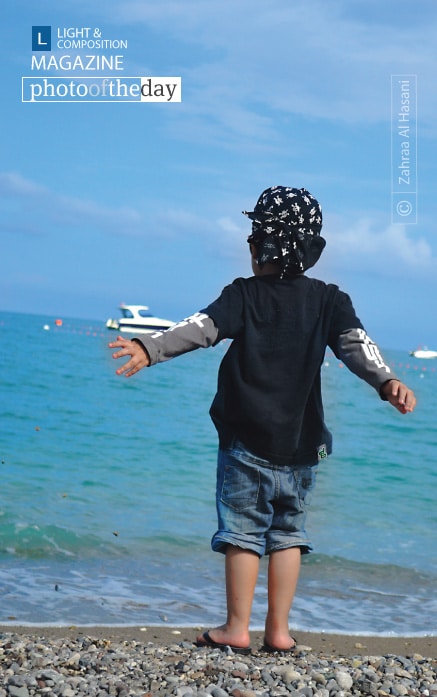
Good Morning Sunshine by Zahraa Al Hassani
In this evocative capture, Zahraa Al Hassani documents a poignant morning moment as her young son greets the day with open arms. The photograph radiates warmth and optimism, perfectly encapsulating the innocence of a new beginning. By focusing on the child’s expansive gesture, the photographer highlights a universal sense of hope and vitality. The image is award-worthy for its candid emotional resonance and the soft, natural light that frames the subject, transforming an everyday domestic scene into a powerful, timeless narrative of love and renewal.
Zara Otaifah
Based in Baghdad, Iraq, Zahraa Al Hassani is a dedicated photographer and professional graphic designer. A graduate of the University of Technology in Baghdad, she balances her creative career at Zain Telecommunications with a deep commitment to the art of purist photography. Her background in graphic design significantly informs her visual perspective, allowing her to blend technical precision with emotional storytelling as she documents the beauty of her family life and surroundings.
Resonance Score Breakdown
Transparency Note: The resonance score (12.8/20) is calculated based on social engagement metrics collected before the award announcement.
Expert Photography Reviews · 8
The First Breath of Light
There is a sacred quality to the way a new day arrives. Before the world begins its noise, before the weight of expectation settles upon our shoulders, there is a brief window of pure potential.
Read the reflection →The Weight of Light
The morning does not ask for permission. It arrives, cold or warm, and finds us exactly where we left ourselves the night before. There is a particular vulnerability in the way a child meets the dawn—arms wide, as if the air itself were a gift to be gathered.
Read the reflection →Reviews & Comments
Share your thoughts about this award-winning photograph. Your reviews contribute to the community engagement score.
The golden, honeyed light washing over the boy’s outstretched limbs recalls the hazy, sun-drenched interiors of Vermeer, where light isn’t merely illumination but a tactile, viscous substance. It’s a palette of warm ochre and soft, dusty amber that makes my own heart ache with a sudden, quiet longing for such unburdened mornings. One finds here a chromatic optimism, a radiant, glowing warmth that transcends the mundane, turning a simple domestic gesture into a luminous, gilded hymn of hope.
Sunlight hits the wall. It’s a sharp, white edge. The boy’s reach is wide, yet the room holds him. I’ve spent minutes watching that shadow stretch across the floor. It’s quiet. The space around him isn’t just air; it’s a breath held before the day begins. Nothing here is accidental. The empty corner is not empty. It’s a stillness I’d give anything to keep. A rare, honest pause in a city that rarely sleeps.
The light here doesn’t just fall; it breathes. Zahraa waited for that precise, golden spill to catch her son’s reach, turning a simple room into a sanctuary. I’ve spent enough mornings watching the sun climb to recognize the stillness she held while the shutter clicked. It’s a quiet prayer of light. Looking at those small, open arms, I feel a sudden, sharp ache for the uncomplicated hope we all once carried. It’s beautiful, truly.
Most candid shots of children are saccharine, but this one avoids the trap. The 45mm focal length keeps the perspective honest, grounding the boy’s reach in a tangible, dusty Baghdad morning. It’s the light catching his fingertips that gets me—it feels like a genuine prayer for the future. Of the thousands of domestic scenes I’ve reviewed, this endures because it doesn’t ask for sentimentality; it simply demands we acknowledge the resilience inherent in a child’s morning.
At f/5.3, the Nikon’s sensor captures a shallow depth of field that isolates the boy’s reach against the soft, atmospheric haze of a Baghdad morning. The lens resolves the fine texture of his skin with surprising clarity, avoiding the diffraction limit that often plagues entry-level glass. I’m genuinely moved by how the light refracts through the dust motes; it’s a fragile, optical grace. It’s rare to see such technical restraint elevate a simple, candid moment into something truly luminous.
Before the eye identifies the child, something in the chest softens. It’s the sudden, expansive reach of those small arms that triggers a visceral, involuntary exhale. I’ve returned to this morning light three times today, and each time, it’s the quiet defiance of that gesture against the backdrop of Baghdad that catches in my throat. It doesn’t just capture hope; it forces a physiological shift, a brief, necessary suspension of the world’s weight. I feel lighter.
The frame suffers from a lack of geometric containment. While the subject’s reach suggests an expansive gesture, the background clutter fractures the picture plane, bleeding energy away from the central mass. It’s a chaotic spill of light that doesn’t anchor the child within the space. I’ve grown weary of such loose framing; it’s structurally hollow. The composition fails to resolve the tension between the subject and the environment. It’s just noise, really.
1/2000sec at f/5.3, ISO 400, 45mm. A shutter speed of 1/2000sec is overkill for a static domestic scene; it’s a waste of light that forced an unnecessary ISO bump. The D3100 sensor doesn’t handle that noise well. At f/5.3, the depth of field is adequate, but the technical inefficiency bugs me. I’ve seen better sensor management in harsher light. It’s a sharp capture, but the math behind the exposure is sloppy. It’s frustratingly close to being perfect.