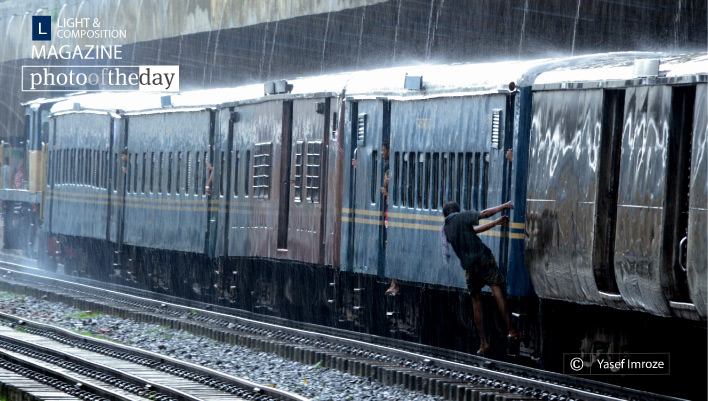
The rain at Kamalapur doesn’t just fall; it hums with the weight of a thousand departures. I’ve felt that sudden, heavy dampness on my own skin, the way it turns the world into a blurred, grey sanctuary. He stood there, waiting for the boy’s frantic sprint to align with the station’s dim, diffused light. It’s a quiet, aching grace. Looking at this, I feel the boy’s desperate breath catching in the humid, cooling air.
The frame’s architecture is compromised by the chaotic geometry of the platform. While the boy’s trajectory provides a necessary vector, the background clutter fractures the picture plane. It’s a messy, kinetic sprawl that lacks the discipline required for true impact. I’ve seen enough frantic station shots to know when the composition doesn't hold. The spatial tension is lost in the noise. It’s a shame, because the boy’s singular, desperate sprint almost anchors the frame.
Rain doesn't just fall here; it carves the boy’s desperation into the platform’s gloom. I’m struck by how the shadows swallow his path, forcing him to sprint through an abyss of his own making. It’s not a commute; it’s a struggle against the encroaching dark. When I look at those slick, obsidian surfaces, I feel a cold shiver. Imroze understands that light isn't for clarity, but for measuring the depth of our inevitable, lonely endurance.
Before the eye identifies the boy, something in the chest tightens. It’s the sudden, cold weight of rain-soaked fabric against skin. I feel my own pulse quicken, mirroring his desperate sprint toward the departing train. When I return to this a year later, the chaos of Kamalapur fades, leaving only that singular, frantic ache of urgency. It’s a visceral reminder of how we all chase departures, breathless and drenched, hoping we aren't already too late.
Most entries from Kamalapur are just visual noise, but Yasef caught something that’ll actually matter in thirty years. It’s the boy’s posture—that desperate, rain-slicked sprint—that anchors the chaos. I’ve seen thousands of train station shots, yet this one hits differently because the shutter speed didn't just freeze motion; it trapped a specific, frantic hope. It’s a rare, honest slice of human endurance. I honestly felt my own breath hitch watching him reach for that train.
At f/14, the diffraction limit begins to soften the fine textures of the boy’s rain-slicked skin, yet it’s precisely this optical compromise that renders the downpour’s chaotic light so tactile. The 35mm focal plane captures the frantic motion with a sharpness that feels almost visceral. I’m genuinely moved by how the lens resolves those individual droplets against the station’s gloom. It’s a rare moment where physics and human desperation collide, revealing a clarity the naked eye simply misses.
The rain-slicked concrete of Kamalapur bleeds into a bruised, melancholic indigo, a palette reminiscent of Turner’s most tempestuous maritime studies, where the boy’s saturated teal shirt cuts through the gloom like a desperate, luminous prayer. It’s a chromatic collision that leaves me breathless, for the way the damp light clings to his skin feels almost tactile, a shivering, liquid symphony of urgency that makes one’s own heart ache with the sheer, wet weight of his journey.
The platform is slick with rain. A boy runs. He is a blur against the vast, grey concrete of Kamalapur. I’ve spent minutes staring at the wet floor beneath his feet. It’s not just water. It’s the weight of his departure. The station’s scale dwarfs him, yet he holds the frame. Nothing here is accidental. The empty corner is not empty. It’s the silence of a journey beginning. I feel a sudden, sharp ache in my chest.


 The Architecture of Silence
Share your thoughts about this award-winning photograph. Your reviews contribute to the community engagement score.