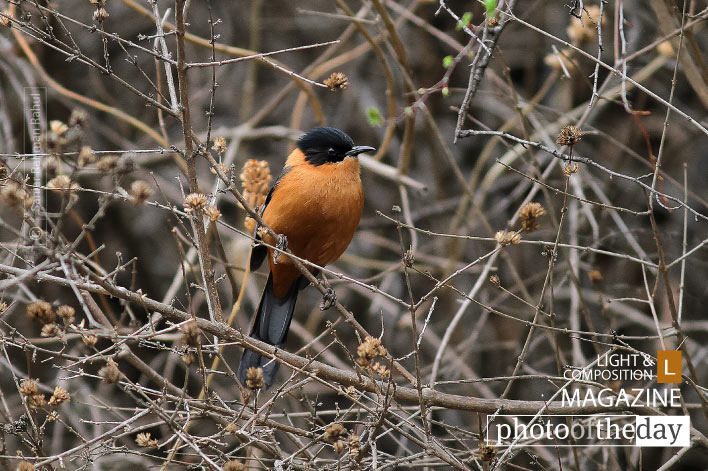
Rufous Sibia by Saniar Rahman Rahul
Captured within the lush, temperate forests of Punakha, Bhutan, this portrait of the Rufous Sibia highlights the delicate elegance of this small member of the Timaliidae family. The photographer utilized a 300mm lens to isolate the bird against the soft, natural backdrop of its Himalayan habitat, capturing it in a moment of quiet foraging. The image is a testament to the patience required in wildlife photography, showcasing the bird's vibrant plumage and intricate details. Its award-worthy quality lies in the perfect balance of technical precision and the intimate, respectful portrayal of a species in its natural environment.
Saniar Rahman Rahul
Based in Dhaka, Bangladesh, Saniar Rahman Rahul is an accomplished Art Director at Grey Worldwide with a career deeply rooted in the visual arts. His photographic journey began in childhood, inspired by his father’s work, and was later refined through his extensive professional background in graphic design and advertising. Since rediscovering his passion for the lens in 1997, Rahul has become a recognized figure in international photography, known for his keen eye and technical expertise in capturing the natural world.
Resonance Score Breakdown
Transparency Note: The resonance score (13.0/20) is calculated based on social engagement metrics collected before the award announcement.
Expert Photography Reviews · 8
The Quiet Observer
I spent twenty minutes this morning just watching a sparrow hop across my balcony railing. I had a pile of emails waiting and a grocery list on the counter, but for a moment, none of it felt urgent. The bird didn't know about my deadlines or the weather report.
Read the reflection →The Architecture of a Breath
To be still is not to be empty; it is to be full of everything that is happening just out of sight. We spend our lives rushing toward the next horizon, our footsteps heavy with the noise of the day, forgetting that the world is held together by the quietest movements.
Read the reflection →Reviews & Comments
Share your thoughts about this award-winning photograph. Your reviews contribute to the community engagement score.
The forest in Punakha doesn’t just hold this bird; it breathes with it. I’ve spent enough mornings in the damp Himalayan air to know the stillness Saniar felt while waiting for that soft, diffused light to settle on the Sibia’s feathers. It’s a quiet, holy sort of foraging. Looking at the way the background melts into a gentle, mossy blur, I feel a sudden, sharp ache for that silence. He listened, and the land finally spoke.
Of the thousands of wildlife portraits I’ve reviewed, most are just technical exercises. This one survives because of the Sibia’s eye. It’s not just sharp; it’s piercing, holding a quiet intelligence that makes me feel like an intruder in those Bhutanese woods. The shallow depth of field isolates the bird perfectly, but it’s that singular, focused gaze that ensures this won’t be forgotten in thirty years. It’s a rare, honest connection in a crowded field.
At f/4, the 300mm lens renders the Sibia’s plumage with surgical acuity, pushing right against the diffraction limit. The focal plane is razor-thin, isolating the bird’s eye with a clarity that reveals the iris’s intricate structure. I’m genuinely moved by how the bokeh, as a function of that wide aperture, dissolves the Himalayan foliage into a soft, painterly wash. It’s a rare moment where the optics don’t just record the subject; they elevate it into pure, luminous geometry.
The Rufous Sibia doesn’t merely perch; it exists within a fragile, suspended silence. I’m struck by how the shadows clinging to the bird’s plumage aren’t just lack of light, but the very weight of the Himalayan air. It’s a somber, deliberate isolation. When I look at those dark, blurred depths behind the creature, I feel a sudden, sharp ache for the wild things that refuse to be fully known. It’s a haunting, quiet defiance.
The burnt-sienna plumage of the Rufous Sibia bleeds into the soft, mossy bokeh of the Punakha forest, creating a chromatic dialogue that reminds one of Morandi’s muted, meditative stillness. It’s a delicate, earthy symphony of ochre and lichen-green that I find utterly intoxicating. One cannot help but feel the damp, cool air of the Himalayas clinging to those feathers, a subtle, atmospheric weight that makes the bird’s quiet foraging feel like a sacred, hushed secret.
One doesn’t capture a Sibia by wandering through Punakha with a camera dangling from one’s neck. It’s a skittish creature, and the soft, creamy bokeh here suggests a photographer who spent hours motionless, likely shivering in the damp Himalayan air. I’ve spent enough mornings in similar brush to recognize the cost of that focus. It’s a quiet, earned piece of work. I find myself genuinely envious of the stillness required to get this close.
The branch ends. The bird lingers. It’s a study in suspension. I’ve spent minutes watching the blur of the Punakha forest recede behind those feathers. The background isn’t just bokeh; it’s a breath. Nothing here is accidental. The empty corner is not empty. It’s the weight of the air between the Sibia and the lens. I feel a sudden, sharp stillness in my own chest. It’s enough. It’s everything.
The Rufous Sibia occupies the frame with calculated precision. Its diagonal posture creates a necessary fulcrum, balancing the weight of the plumage against the soft, blurred depth of the Punakha forest. The negative space isn’t merely empty; it’s a deliberate buffer that prevents the subject from collapsing into the background. It’s rare to find such disciplined geometry in wildlife work. I’ve grown weary of cluttered frames, but this one holds its own. It’s structurally sound.