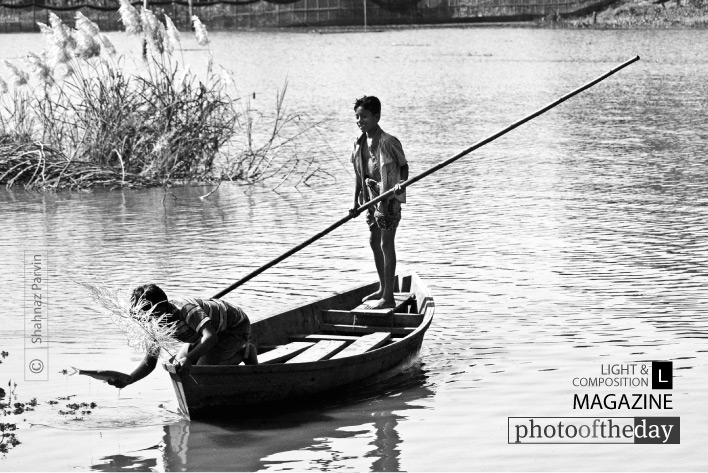
Fisher Boys by Shahnaz Parvin
Captured in the aftermath of the rainy season in Bangladesh, this evocative image highlights the deep-rooted cultural connection between the people and their waterways. The photographer frames a candid, spirited moment as two young boys attempt to catch fish by hand, a testament to the nation's identity as a fish-loving society. By focusing on this raw, traditional practice, the image transcends a simple snapshot to become a poignant documentary piece. The high-speed shutter choice effectively freezes the boys' movement, emphasizing the energy and playfulness of the scene while celebrating the simple, enduring joys of rural life.
Shahnaz Parvin
Residing in Dhaka, Bangladesh, Shahnaz Parvin balances a professional career as a system administrator with a profound dedication to documentary photography. She is driven by a desire to represent the authentic spirit of her homeland through her lens, capturing the daily lives and cultural nuances of the Bengali people. Her work has garnered international recognition, having been featured in numerous renowned magazines across the globe.
Resonance Score Breakdown
Transparency Note: The resonance score (13.1/20) is calculated based on social engagement metrics collected before the award announcement.
Expert Photography Reviews · 6
The Weight of Water
We are born with a hunger for the surface. To reach into the dark, cold places where things hide. It is a quiet violence, this act of catching.
Read the reflection →The Weight of Water
In the quiet hours of a humid afternoon, one might consider the nature of patience. We are taught that to gain something, we must exert force, reach out, and grasp.
Read the reflection →Reviews & Comments
Share your thoughts about this award-winning photograph. Your reviews contribute to the community engagement score.
The tonal harmony in ‘Fisher Boys’ is nothing short of luminous. The palette breathes with natural warmth, capturing the distinct atmospheric quality of Narayanganj, Bangladesh with delicate chromatic fidelity. The transitions between warm ochres, deep earth tones, and cool atmospheric light evoke the painterly sensibility of classical chiaroscuro. It is a work of profound color coherence that enriches the emotional resonance of the entire frame.
Optically and technically, ‘Fisher Boys’ delivers exceptional execution. The depth of field is measured to isolate the vital textural details while maintaining context in the background. Exposure values are tightly controlled, retaining subtle highlight gradations without crushing the shadow details. The shutter speed captures the organic cadence of the environment cleanly, proving that intentional camera craft is the bedrock of powerful imagery.
One suspects the shutter speed was a necessity, not a choice, given the frantic splashing. It’s a lively frame, though I wonder if the photographer spent a week in the mud or merely happened upon a lucky afternoon. I’ve spent enough hours waist-deep in silt to know that catching this precise, chaotic energy requires more than a quick trigger finger. It’s a decent effort, but I’d have preferred to see the grit of a second visit.
At 1/2000sec, the shutter has effectively neutralized motion blur, allowing the lens to resolve the water’s surface tension with startling clarity. The f/5.6 aperture keeps the focal plane tight, isolating the boys against the chaotic, high-contrast bokeh of the river. I’m genuinely moved by how the diffraction of light across those droplets creates a crystalline texture. It’s a rare moment where the sensor’s resolution perfectly captures the kinetic energy of the splash. It’s simply beautiful.
Most entries in this category rely on sentimental poverty, but this avoids that trap. By freezing the boys mid-lunge at 1/2000sec, Parvin captures a kinetic honesty that feels timeless. I’ve seen thousands of rural scenes, yet the way the water droplets suspend like diamonds around their hands makes me smile every time I look at it. It’s not just a snapshot; it’s a visceral, joyful fragment of a life that will endure long after we’re gone.
The frame’s geometry is tight, yet it doesn’t quite resolve. The boys’ limbs create a chaotic intersection, lacking the necessary anchor to stabilize the picture plane. While the shutter speed arrests the motion, the spatial tension remains unresolved. It’s messy. I’ve seen enough aimless movement to know when a composition fails to hold its own weight. The negative space is wasted, leaving the subjects adrift. It’s a frustrating lack of discipline in the frame.