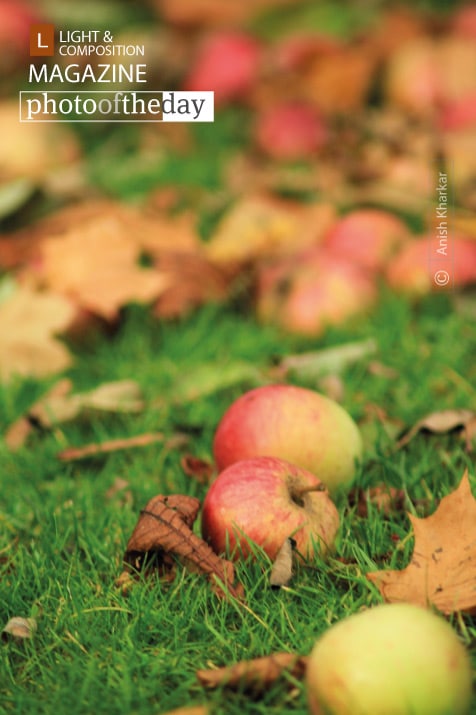
Apples in Autumn by Anish Kharkar
Captured during a transformative period of study in the United Kingdom, this image reflects the photographer's first encounter with the vivid, seasonal transition of an authentic autumn. Drawn to the scattered bounty of fallen fruit across a local football ground, the photographer utilized a telephoto lens to isolate the textures and rich colors of the harvest. The composition highlights the quiet beauty of nature's decay, turning a simple scene into a poignant study of light and color. This photograph is award-worthy for its ability to find profound, artistic significance in the mundane details of everyday life, showcasing a keen eye for natural subjects.
Anish Kharkar
Originally from Mumbai, India, Anish Kharkar relocated to the island of Mauritius over a decade ago, where he developed a deep appreciation for the region's natural splendor and cultural diversity. A graduate of Cranfield University in the United Kingdom with a Masters in Aerospace Vehicle Design, he transitioned photography from a casual hobby into a dedicated creative pursuit. His diverse portfolio spans macro, astrophotography, and pet portraiture, all unified by a commitment to preserving life's fleeting, beautiful moments through a technical and observant lens.
Resonance Score Breakdown
Transparency Note: The resonance score (11.8/20) is calculated based on social engagement metrics collected before the award announcement.
Expert Photography Reviews · 4
The Weight of the Harvest
There is a specific gravity to the end of a season, a quiet surrender that happens when the branch finally lets go. We spend so much of our lives reaching upward, straining toward the sun, convinced that our worth is measured by how long we can hold on.
Read the reflection →The Weight of What Falls
I was walking through the park this morning when I stopped to pick up a single, bruised apple from the grass. It felt heavy and cold in my palm, a small, forgotten thing that had simply let go of the branch when its time came.
Read the reflection →Reviews & Comments
Share your thoughts about this award-winning photograph. Your reviews contribute to the community engagement score.
Most nature photography is just pretty wallpaper, but this holds weight. By using a 300mm lens to compress the depth, Kharkar forces the viewer to confront the rot alongside the color. It’s a brave choice; most photographers would’ve sought a cleaner subject. I find myself genuinely moved by the bruised skin of these apples against the damp grass. It’s a quiet, decaying truth that’ll still feel relevant in thirty years, long after the digital files are forgotten.
Decay isn’t merely a seasonal transition; it’s a confrontation with finitude. Kharkar’s apples, scattered across the cold turf, don’t just sit there—they surrender to the encroaching dark. I’ve stared at these bruised skins until my own pulse slowed, feeling the weight of their inevitable rot. It’s a quiet, brutal honesty. Most photographers fear this gloom, but here, the shadows aren’t empty. They’re the heavy, silent witnesses to a harvest that’s already lost its purpose.
The grass holds the weight of the season. It’s quiet here. I’ve spent minutes watching the way the fruit rests against the blades. It doesn’t demand attention. It simply exists. The frame isn’t crowded by the harvest; it’s defined by the distance between the apples. I feel a sudden, sharp ache for the cooling air of Cranfield. Nothing here is accidental. The empty corner is not empty. It’s the breath between the falling and the rot.
The frame’s compression is its primary failure. By flattening the spatial depth with a 300mm lens, the apples lose their necessary weight against the turf. The composition lacks a clear fulcrum, leaving the eye to drift across a chaotic, unanchored surface. It’s a messy arrangement that doesn’t hold. I’ve rarely seen such potential for geometric order squandered by a lack of discipline. The negative space is entirely absent, and frankly, the lack of structural rigor here irritates me.