The Inner Circle by Erly Bahsan
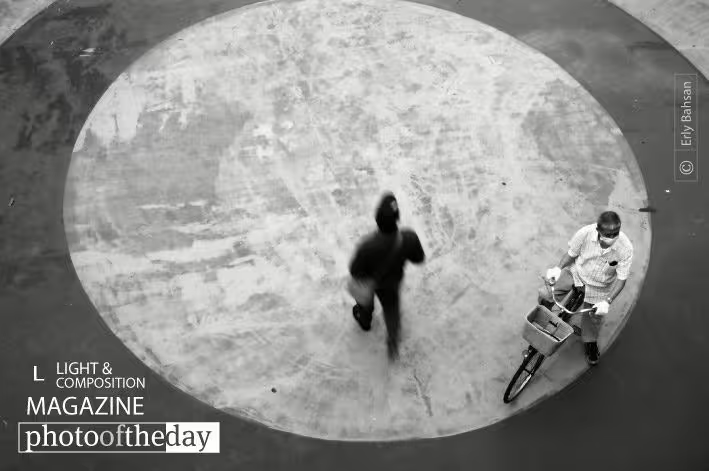
Captured near a junction by Daan Park in Taipei, this evocative street photograph centers on a large circular motif in the ground that frames a fleeting encounter between two men. The photographer highlights the cultural nuance of mask-wearing in Taipei, where individuals often isolate themselves to prevent the spread of illness. By choosing a black-and-white medium, the image strips away distractions to focus on the raw, honest expressions of the subjects. The composition is award-worthy for its ability to transform a mundane urban moment into a poignant narrative about social distance, anonymity, and the human spirit within a bustling city.
Erly Bahsan
Originally from Bogor, Indonesia, Erly Bahsan is currently based in Taipei, Taiwan, where he balances his academic pursuits in Geotechnical Engineering with a deep passion for street photography. He specializes in candid, black-and-white imagery, striving to remain an invisible observer who captures the authentic soul and spirit of urban life. Driven by a love for travel and a desire to document diverse cultures, he continuously refines his ability to merge into the crowd to reveal the honest, unposed expressions of his subjects.
Resonance Score Breakdown
Transparency Note: The resonance score (14.7/20) is calculated based on social engagement metrics collected before the award announcement.
Expert Photography Reviews · 6
The Geometry of Solitude
We are all architects of our own perimeters, drawing invisible lines in the dust to mark where the self ends and the rest of the world begins.
Read the reflection →The Geometry of Distance
We walk through cities as if they were forests. We navigate the concrete, the intersections, the sudden intersections of strangers. There is a safety in the lines we draw around ourselves.
Read the reflection →Reviews & Comments
Share your thoughts about this award-winning photograph. Your reviews contribute to the community engagement score.
The concrete circle pulls the eye inward, a quiet sanctuary amidst Taipei’s rush. I’ve spent enough time waiting for the light to know that Erly didn’t chase this; he let the geometry hold the silence. Those masks aren’t just barriers; they’re veils of solitude. It’s haunting how the low, grey light flattens the world, making these two men feel like ghosts in a stone orbit. I find myself holding my breath, just watching them drift by.
The circular geometry dictates the frame’s internal logic. It’s a rigid anchor, forcing the subjects into a precise, claustrophobic orbit. The negative space surrounding the concrete ring creates a necessary vacuum, isolating the figures against the urban sprawl. It’s cold, calculated, and structurally sound. I’ve rarely seen a frame so effectively weaponize its own boundaries. The composition doesn’t just hold; it traps. It’s a brutal, elegant exercise in spatial tension that demands total visual obedience.
The circular geometry here isn’t merely a frame; it’s a cage for the soul. Bahsan understands that in Taipei, the mask is a veil against existence itself. I’m struck by how the shadows bleed into the concrete, swallowing the men’s feet. It’s a cold, existential erasure. When light fails to penetrate the center, we are left with the silence of the void. It’s haunting, really. I’ve never felt such a profound, heavy ache for anonymity.
One suspects Erly spent a fair few afternoons pacing that Taipei junction before the geometry aligned. It’s a patient man’s game, waiting for the subjects to drift into that concrete circle just so. I’ve spent enough hours shivering on street corners to recognize the discipline here. It isn’t a lucky snap; it’s a quiet, earned victory. I find myself genuinely envious of the timing. It’s a sharp, cold observation of urban isolation, perfectly framed.
Of the thousands of street shots I’ve reviewed, most vanish within a week. This one sticks. The circular geometry doesn’t just frame the men; it traps them in a geometric loneliness that feels prophetic now. I’ve seen countless mask-wearing shots, but Bahsan’s choice to prioritize the harsh, concrete ring over the faces makes the isolation absolute. It’s haunting. In thirty years, we’ll look back at this and finally understand exactly what we were feeling.
Stripping away the chromatic spectrum reveals a profound, charcoal-heavy silence, reminiscent of Morandi’s dust-choked still lifes, where the absence of hue forces one to confront the stark, silver-grey geometry of Taipei’s concrete. It’s a haunting, monochromatic ache; I’m genuinely unsettled by how the light clings to those masks like cold, wet plaster. One finds that by abandoning the warmth of the sun, Bahsan captures the true, shivering isolation of a city caught in a grey, breathless void.