Stairway to… by Ruben Alexander
Captured at the historic Tangasseri Point Lighthouse in Kerala, this photograph highlights the striking architectural geometry of a 1902 structure. The photographer utilized a long exposure of 2.5 seconds at f/16 to emphasize the intricate details of the lighthouse's interior, drawing the viewer’s eye up the spiraling ascent. By balancing the technical demands of low-light interior photography with the historical significance of the site—a beacon that has guided mariners for over a century—the image transforms a functional maritime tool into a compelling study of light, shadow, and industrial heritage. It is an evocative tribute to the intersection of colonial history and modern engineering.
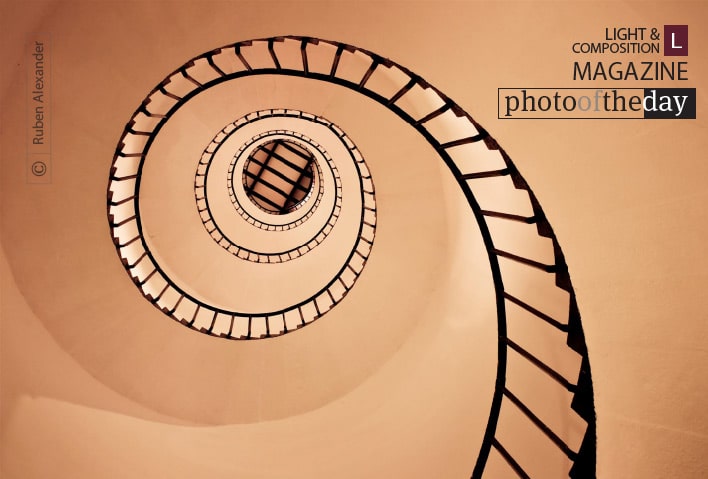
Exposure 2.5sec @ f/16 | ISO 200 | Focal Length 27mm
Ruben Alexander
Based in Bangalore, India, Ruben Alexander balances a professional career in the technology sector with a dedicated pursuit of photography. As a self-taught artist, he views the camera as a vital outlet for creative expression and personal rejuvenation. His portfolio spans a diverse range of subjects, including nature, macro, and still life, while he continues to expand his expertise into the realms of landscape, portrait, and street photography.
Resonance Score Breakdown
Transparency Note: The resonance score (13.2/20) is calculated based on social engagement metrics collected before the award announcement.
Expert Photography Reviews · 8
The Weight of Ascent
We are taught that to climb is to arrive. We build structures that spiral upward, convinced that the next step brings us closer to a clarity that does not exist on the ground. But the climb is not a journey toward a destination.
Read the reflection →The Geometry of Ascent
We are all, in some measure, creatures of the spiral. We climb through the days, circling the same central axis of our own lives, hoping that each rotation lifts us a fraction higher than the last.
Read the reflection →Reviews & Comments
Share your thoughts about this award-winning photograph. Your reviews contribute to the community engagement score.
The spiral at Tangasseri doesn’t merely ascend; it consumes. By holding the shutter for those two seconds, Alexander forces the architecture to surrender its secrets to the dark. I’ve spent minutes staring into the throat of this lighthouse, and it’s terrifying—a hollow, metallic gullet that swallows the light before it can reach the top. It isn’t just geometry. It’s a reminder that we are all climbing toward a void that refuses to be illuminated.
A 2.5-second exposure inside a lighthouse suggests someone didn’t just stumble upon the shot. It’s a cramped, dizzying climb, and I’ve spent enough time in such stairwells to know the damp chill that settles into one’s bones. The geometry here is disciplined, not accidental. It’s rare to see a Rebel XSi pushed this far with such composure. One suspects the photographer returned until the light behaved. It’s a quiet, earned ascent. I rather like it.
The ochre of these spiraling walls, reminiscent of a weathered Morandi still life, breathes with a dusty, colonial melancholy that I find utterly intoxicating. It’s not merely architecture; it’s a rhythmic pulse of shadow and light, where the pale, sun-bleached cream of the stone meets the deep, bruised indigo of the shadows. One feels the weight of the salt air, a chromatic ache that lingers in the throat long after the eye has turned away.
The spiral pulls the eye upward. It’s a rhythmic climb. I’ve spent minutes tracing the iron curves, waiting for the light to settle. There’s a stillness here that feels heavy, almost ancient. The shadows don’t just hide; they hold the space. It’s quiet. I feel a sudden, sharp ache for the climb itself. Nothing here is accidental. The empty corner is not empty. It’s a breath held in the dark. A perfect, hollow grace.
The spiral’s geometry dictates the viewer’s path. It’s a rigid, mathematical ascent. The central void creates a necessary tension, pulling the eye toward the apex with clinical precision. While the shadows lack depth, the structural repetition holds the frame together. I’ve rarely seen such a disciplined use of negative space in a lighthouse interior. It doesn’t rely on sentiment. The composition demands total submission to its axis. It’s a cold, calculated triumph of form over history.
Most architectural shots of this lighthouse fall into the trap of mere documentation. What separates this from the field is the deliberate choice of a 2.5-second exposure, which softens the light into a tangible, velvet weight. It’s a rare moment where geometry doesn’t just sit there; it breathes. I’ve seen thousands of staircases, but this one makes me feel dizzy in the best way possible. It’ll still command attention in thirty years because it captures stillness perfectly.
The spiral pulls the eye upward, a rhythmic pulse of iron and shadow. I’ve stood in such hollow, echoing spaces, feeling the weight of the sea air pressing against the stone. Ruben waited for the light to settle into these curves, letting the long exposure soften the climb. It’s a quiet, breathless ascent. Looking at it, I feel a sudden, sharp ache for the solitude of that lighthouse, listening to the history trapped within its walls.
At f/16, the diffraction limit begins to soften the fine ironwork, yet it’s a necessary compromise for that deep focal plane. The 2.5-second exposure captures the light’s decay perfectly as it climbs the spiral. I’m genuinely moved by how the lens resolves the dust motes suspended in the shaft; it’s a ghostly, tactile reminder of the air itself. It doesn’t just document a lighthouse; it maps the very physics of the space. It’s hauntingly precise.
Congrats to the winner, beautiful work.