The Unmapped Path
Cities are often defined by their infrastructure—the rigid grids, the asphalt arteries, and the transit lines that dictate how we move from one point to another. We build these systems to impose order on the landscape, assuming that efficiency is the primary goal of human geography. Yet, when the machinery of the city fails—when the snow falls and the roads vanish—the true nature of our relationship with space is revealed. We see then that the city is not merely a collection of concrete and steel, but a living, breathing entity that exists independently of our planning. In these moments of paralysis, the hierarchy of the street dissolves. The person who navigates by foot or by animal becomes the only one truly connected to the terrain, while the rest of us are left stranded in our own stalled inventions. It forces us to consider who actually owns the space when the official systems are stripped away. Is the city a place for the machine, or is it a place for the inhabitant?
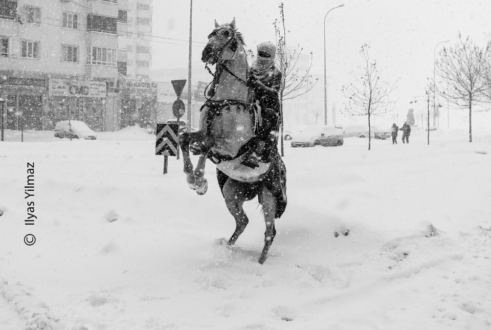
Ilyas Yilmaz has captured this tension in his evocative image titled A Horseman. It serves as a reminder that even when the modern world grinds to a halt, the human spirit finds a way to traverse the silence. Does this image make you wonder who is left behind when the city stops moving?