The Weight of Distance
Geologists speak of strata as if time were merely a matter of stacking. They see the earth as a ledger, each layer a page recording a season of heat, a flood, or a long, quiet period of dust. We are taught to view the horizon as a flat line, a boundary that marks where the world ends and the sky begins. But if you stand still long enough, the horizon ceases to be a line and becomes a depth. It is a series of veils, one pulled back to reveal another, suggesting that nothing is ever truly singular. We move through our days believing we are walking on a solid, unified surface, yet we are constantly traversing these invisible, overlapping histories. The ground beneath us is not just dirt; it is a collection of moments that have settled, one upon the other, waiting for a specific quality of light to reveal their distinct edges. If we could see the world in its true, layered complexity, would we still feel so certain of where we stand?
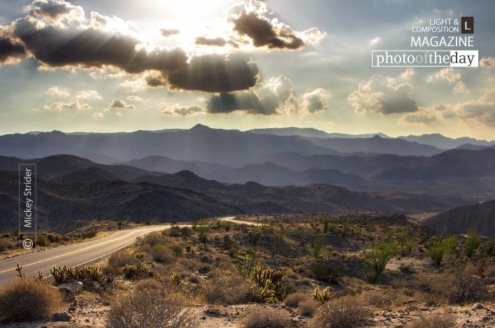
Mickey Strider has captured this sense of unfolding time in the image titled Anza-Borrego Layers. It reminds me that the landscape is never just a place, but a conversation between the earth and the sky. Does the light reveal the layers, or does it simply invite us to notice them?