The Weight of Grace
There is a peculiar physics to the way some things move through the world, as if they are not entirely subject to the gravity that anchors the rest of us. We spend our lives tethered to the earth, calculating the friction of our own footsteps, while others seem to exist in a state of perpetual suspension. I often think of the way a ribbon behaves in a strong wind—how it loses its own shape to become a part of the air itself, trailing behind the movement like a memory that refuses to let go. It is a form of surrender, really. To be so light, so elongated, so seemingly fragile, and yet to navigate the dense, tangled thickets of a forest without ever losing one’s poise. We admire this because it is the opposite of how we live. We are heavy with our intentions, our plans, and our baggage. We move through our days with a deliberate, often clumsy, weight. But what if we could simply trail behind ourselves, a long, elegant wake of who we were a moment ago?
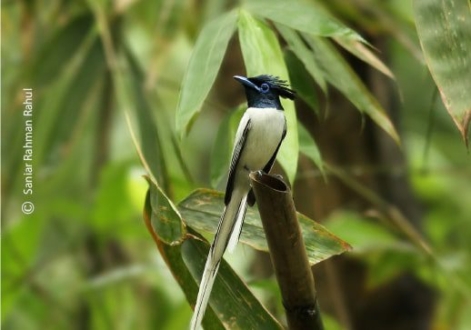
Saniar Rahman Rahul has captured this fleeting grace in his work titled Asian Paradise-Flycatcher. It serves as a quiet reminder that even in the thickest canopy, there is room for something to move with such effortless poise. Does it make you wonder what we might leave behind if we moved through our own lives with such lightness?