The Weight of the Fiber
In the quiet corners of history, we often forget that civilization was built not on stone or steel, but on the stubborn, fibrous strands of the earth. We wear our history, yet we rarely consider the hands that pulled it from the mud. There is a specific, ancient rhythm to the act of extraction—a bending of the spine, a submersion of the self into the elements, a negotiation between the human body and the unyielding nature of the harvest. It is a slow, repetitive prayer performed in the water, where the line between the worker and the work begins to blur. We tend to value the finished object, the smooth fabric or the sturdy rope, while ignoring the damp, heavy labor that precedes it. To stand in the water is to accept a certain kind of surrender, a belief that the effort itself is a form of language. How much of our own comfort is tethered to these unseen, submerged lives, and what remains of us when the water finally recedes?
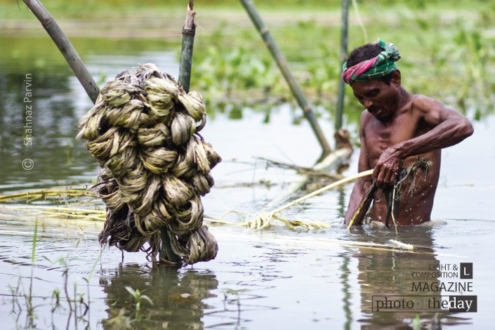
Shahnaz Parvin has captured this profound connection in her work titled The Craftsman of Jute. She reminds us that behind every thread lies a story of endurance that rarely makes it into our daily conversations. Does the weight of the harvest feel any lighter when it is shared?