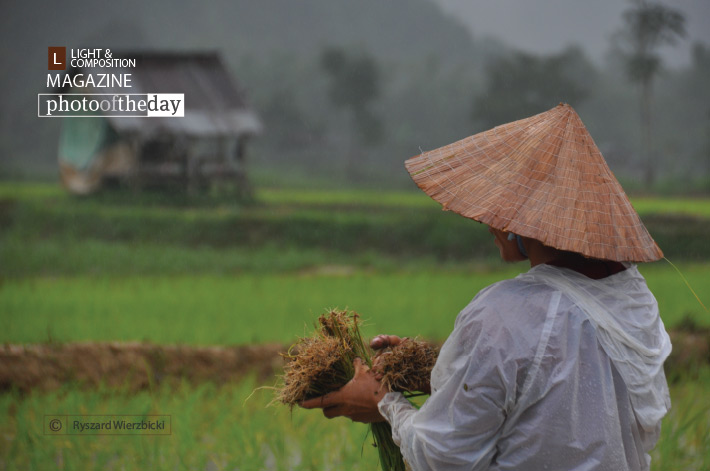
Ploughing Rice by Ryszard Wierzbicki
Captured in the lush landscapes of Vang Vieng, Laos, this photograph documents the rhythmic, enduring labor of local villagers during the rainy season. The photographer utilized a long focal length to isolate the subject against the expansive, verdant rice fields, emphasizing the physical connection between the farmer and the land. The image is award-worthy for its authentic portrayal of rural life, capturing a fleeting, timeless moment of agricultural tradition. The composition balances the raw intensity of the ploughing process with the serene, misty atmosphere of the Laotian countryside, offering a poignant narrative of human perseverance and cultural heritage.
Ryszard Wierzbicki
Born in 1963 and a graduate of the University of Gdańsk, Ryszard Wierzbicki transitioned from a diverse career in social sciences and marketing to become a dedicated traveler and photographer after relocating to the United Kingdom in 2006. His work is deeply influenced by his extensive explorations of South-East Asia and his commitment to charitable causes, including his volunteer work with orphans in Thailand and Burma. As the founder of the travel and photography forums Instant Travelling and World Around, Wierzbicki balances his professional life as a marketing advisor with a profound passion for documenting global cultures and landscapes.
Resonance Score Breakdown
Transparency Note: The resonance score (12.6/20) is calculated based on social engagement metrics collected before the award announcement.
Expert Photography Reviews · 6
The Weight of the Furrow
To break the earth is a quiet violence. We do it to survive, turning the soil over so that something else might rise in its place. There is a rhythm to this labor that predates our names, a slow, heavy movement that demands everything from the muscles and nothing from the mind.
Read the reflection →The Rhythm of the Earth
There is a quiet conversation that happens between the feet and the soil, a language older than words. We often forget that we are not merely walking upon the earth, but are part of a cycle that breathes through us.
Read the reflection →Reviews & Comments
Share your thoughts about this award-winning photograph. Your reviews contribute to the community engagement score.
Most travel photography is just tourism masquerading as art, but this works because of the compression. By using 232mm, Wierzbicki flattens the distance between the farmer’s struggle and those looming, indifferent mountains. It’s a brutal, honest scale. I’ve seen thousands of rice field shots, but the way the mud splashes against the stillness here actually made me hold my breath. It’s not just a scene; it’s a record of a rhythm that’s slowly vanishing from our world.
At 232mm, the compression of the focal plane renders the humid Laotian atmosphere with startling density. Shooting at f/6.0, Wierzbicki avoids the diffraction limit while maintaining enough depth to articulate the mud’s texture against the soft, out-of-focus verdancy. I’m genuinely moved by how the lens resolves the water’s surface tension; it’s a tactile, microscopic clarity that the naked eye simply misses. It’s not just a scene; it’s a precise optical capture of human rhythm.
In the mist of Vang Vieng, we see a man tethered to the earth. He isn’t just working; he’s in a dialogue with the mud and the rain. Ryszard used that long lens to pull him close, letting us hear the silence of his labor. I feel a sudden, quiet ache in my own shoulders watching him. It’s a portrait of endurance that doesn’t need words. This is a photograph that asks to be returned to.
The mist in Vang Vieng doesn’t just hang; it breathes. Ryszard waited for that precise, heavy stillness where the earth and sky blur into one. I feel a quiet ache in my own shoulders watching that farmer lean into the mud. He stood there in the cooling, humid air, listening to the land’s slow rhythm. It’s a rare, sacred patience. You can’t rush this light; you have to let it find you first.
1/500sec at f/6.0, 232mm. A tight compression of the frame. The shutter speed is adequate to freeze the motion, but f/6.0 on a DX sensor at that focal length is a gamble. It’s sharp enough, though the background separation feels forced. I’ve spent too long staring at these muddy fields, yet the technical discipline here actually holds my attention. It’s a clean execution. The optics didn’t fail the intent. That’s rare enough to respect.
The mist in Vang Vieng doesn’t just soften the frame; it devours the horizon, forcing the farmer into a lonely, existential struggle against the mud. I’ve stared at these dark, heavy furrows until my eyes ached. It’s not about the rice. It’s about the silence of the earth reclaiming the man. When the light fails to penetrate that dense, grey vapor, we’re left with the raw, brutal weight of human endurance. It’s hauntingly, painfully beautiful.