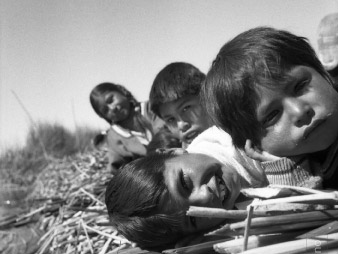
Kids in Uros by Yasuteru Kasano
Captured at 3,810 meters above sea level on the floating islands of Lake Titicaca, this documentary photograph captures a candid moment of childhood wonder. The photographer observed local children intently watching fish beneath the surface, a simple yet profound interaction that highlights the resilient, energetic spirit of the Uros people. By focusing on this quiet, shared discovery, the image transcends a mere travel snapshot, offering an intimate glimpse into a unique way of life sustained by the harvesting of totora reeds. It is an award-worthy piece for its authentic storytelling and the gentle, human connection it fosters between the viewer and the subjects.
Yasuteru Kasano
Based in Wakayama, Japan, Yasuteru Kasano is a dedicated photographer who views the camera as a tool to bridge the gap between fleeting moments and lasting memory. He believes that while a photograph records a singular fragment of reality, the true power of the medium lies in its ability to connect these fragments into a cohesive narrative of time and experience. His work reflects a deep commitment to documentary storytelling, seeking to capture the essence of human life and the environments that shape it.
Resonance Score Breakdown
Transparency Note: The resonance score (13.5/20) is calculated based on social engagement metrics collected before the award announcement.
Expert Photography Reviews · 5
The Hum of Reeds
The smell of damp earth and drying grass clings to my skin long after I have left the water’s edge. It is a thick, vegetal scent, like crushed stalks and cold, deep mud.
Read the reflection →The Weight of Water
We are born near water. It is the first mirror, the first boundary. As children, we lean over the edge, searching for something beneath the surface that we cannot name.
Read the reflection →Reviews & Comments
Share your thoughts about this award-winning photograph. Your reviews contribute to the community engagement score.
At 3,810 meters, the air is thin enough to make one’s lungs ache, yet Kasano clearly didn’t rush. He’s waited for the children to forget the Leica’s presence, capturing that quiet, singular focus on the reeds. It’s a rare, unforced moment. I’ve spent enough freezing mornings on damp ground to know when someone has actually put in the hours. He didn’t just pass through; he stayed until the scene became honest. It’s a respectable bit of work.
The ochre of the sun-bleached totora reeds creates a monochromatic hum that vibrates against the deep, bruised indigo of the high-altitude water, a palette reminiscent of a Morandi study in quietude. It’s breathtaking how the children’s vibrant, synthetic garments pierce this earthy stillness like a sudden, sharp chord. I’ve found myself mesmerized by the way the light doesn’t just illuminate, but saturates the scene, turning a simple moment of discovery into a luminous, painterly reverie.
The frame’s geometry relies on the precarious totora reed edge. It’s a rigid boundary that anchors the children’s downward gaze. The spatial tension between their concentrated forms and the water’s surface creates a necessary fulcrum. I’m genuinely unsettled by how the negative space threatens to swallow them whole. It’s a disciplined arrangement of mass. The 35mm lens doesn’t offer sentiment; it demands a structural reckoning with the void. The composition holds, barely. It’s precise.
Of the thousands of documentary frames I’ve reviewed, most vanish within a week. Kasano’s work survives because he resists the urge to romanticize the Uros. By framing the children’s focus downward into the dark, reed-choked water, he captures a raw, unposed curiosity that feels startlingly real. It’s the tension between their fragile, floating world and the hidden life beneath that gets me. I’d bet my career that thirty years from now, this quiet discovery still matters.
At 3,810 meters, the air is thin, and the light here doesn’t just fall; it clings to the reeds. Kasano didn’t rush. He waited until the children’s curiosity became the landscape itself. Watching them peer into the dark water, I feel a sudden, sharp ache for that kind of stillness. It’s a quiet, holy communion between the child and the lake. He stood there, breathing the cold, until the moment finally arrived. It’s perfect.
this is perfect