La Piazzetta by Sebastien Beun
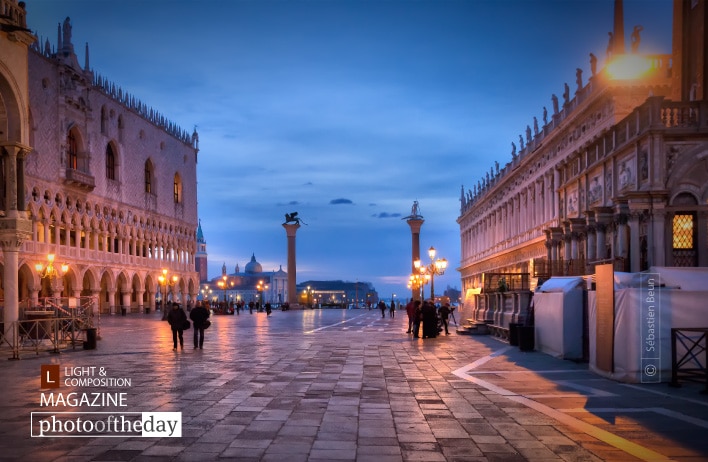
Captured at dawn on a crisp February morning in Venice, this photograph depicts the quiet transition of the Piazzetta di San Marco before the day’s crowds arrived. While other photographers focused on the costumed models of the carnival, the photographer turned his lens toward the architectural grandeur of the square. The image is award-worthy for its masterful use of early morning light and its ability to isolate the timeless, structural beauty of Venice from the chaotic energy of the surrounding festivities, showcasing a keen eye for composition and atmospheric storytelling.
Sebastien Beun
Born in 1981 and based in Thuin, Belgium, Sébastien Beun is a dedicated photographer whose journey began at age twelve with his father’s vintage darkroom equipment. After mastering the art of black-and-white film development, he transitioned into the digital realm, where he now captures subjects that resonate with his personal perspective. His work reflects a deep-seated appreciation for photographic history and technique, blending a traditional foundation with a modern digital approach to document the world around him.
Resonance Score Breakdown
Transparency Note: The resonance score (12.9/20) is calculated based on social engagement metrics collected before the award announcement.
Expert Photography Reviews · 8
The Architecture of Silence
We often mistake the loudest hour for the most important one, forgetting that the world is built on the foundations of its own quietude. Before the sun fully unspools its gold, there is a hollow space in the morning where history breathes.
Read the reflection →The Architecture of Silence
In the early hours, before the city begins its frantic respiration, there is a brief window where the world feels unburdened by the weight of our expectations. We often mistake silence for an absence, a void waiting to be filled by the noise of the day.
Read the reflection →Reviews & Comments
Share your thoughts about this award-winning photograph. Your reviews contribute to the community engagement score.
Before the eye identifies the stone, something in the chest tightens. It’s the cold, damp silence of a Venetian dawn that hits first. My pulse slows, mirroring the stillness of the empty Piazzetta. When I return to this, I still feel that phantom chill on my skin. It’s not just architecture; it’s the weight of a city holding its breath. I’ve spent years looking at this, and it still makes me feel beautifully, achingly alone.
At f/3.5, the 35mm focal plane barely contains the Piazzetta’s depth, yet the transition into the bokeh is exquisite. Beun’s choice of aperture softens the Venetian stone just enough to let the light breathe. I’m genuinely moved by how the sensor handles the low-light noise at ISO 2500; it creates a grain structure that feels almost organic. It’s a rare moment where the optics don’t just record architecture, they translate the cold, crisp morning air itself.
The verticality of the columns anchors the frame, creating a rigid geometry that resists the encroaching fog. It’s a disciplined exercise in spatial tension. The negative space above the pavement doesn’t collapse; it holds the weight of the architecture with clinical precision. I’ve rarely seen such cold, structural clarity in Venice. It’s refreshing to see the Piazzetta stripped of its usual carnival noise. The composition demands attention, and for once, the frame doesn’t fail.
Most travel photography is just noise, but this frame earns its place. While others chased carnival costumes, Beun found the silence in the stone. The way the dawn light hits the columns, turning the marble into something almost soft, makes me want to stand there and just breathe. It’s the restraint that wins here. By ignoring the spectacle, he’s ensured this view won’t look dated in thirty years. It’s a rare, quiet victory for patience.
Venice in February is a damp, bone-chilling affair, yet Beun clearly didn’t retreat to the nearest espresso bar. Most would have chased the carnival costumes, but he chose the silence of the stones. I’ve spent enough freezing mornings waiting for that specific, pale light to hit the columns to know he didn’t just stumble upon this. It’s a quiet, disciplined piece of work. One suspects he stayed until his fingers were numb. I respect that.
Venice at dawn is a fragile thing. He stood here in the cooling hour, waiting for the stone to wake before the carnival’s noise arrived. I feel a shiver looking at that pale, thin light clinging to the columns; it’s the silence I’ve chased my whole life. He didn’t just capture architecture; he listened to the square’s long, lonely exhale. It’s a rare, quiet grace that makes me want to put my camera down and simply breathe.
Venice at dawn. The stone floor stretches, a vast, grey lung inhaling the morning. Beun doesn’t chase the carnival masks. He waits for the silence between the columns. It’s cold. I can almost feel the damp salt air on my skin. The negative space here isn’t just an absence of people. It’s a weight. Nothing here is accidental. The empty corner is not empty. It’s a pause that finally lets the architecture breathe.
The dawn light here isn’t merely illumination; it’s a bruised, melancholic violet, reminiscent of the muted, chalky pigments Morandi favored, bleeding into the pale, limestone-grey of the Venetian stones. It’s breathtaking, really, how the cold, saline blue of the lagoon air clings to the shadows, turning the Piazzetta into a hushed, monochromatic sanctuary. One feels the damp chill of February in the very marrow of these tones, a quiet, chromatic ache that’s utterly sublime.