Little Friends by Kirsten Bruening
Captured during a visit to the Cologne Zoo, this photograph highlights the quintessential behavior of meerkats as they stand guard. The photographer utilized a 300mm focal length to isolate the subjects, capturing their attentive, upright stance against a soft background. By focusing on the social dynamics and the alert nature of these animals, the image offers a compelling glimpse into their communal life. The technical precision, combined with the sharp focus on the meerkats' expressive features, makes this a standout wildlife portrait that effectively communicates the charm and vigilance of the species.
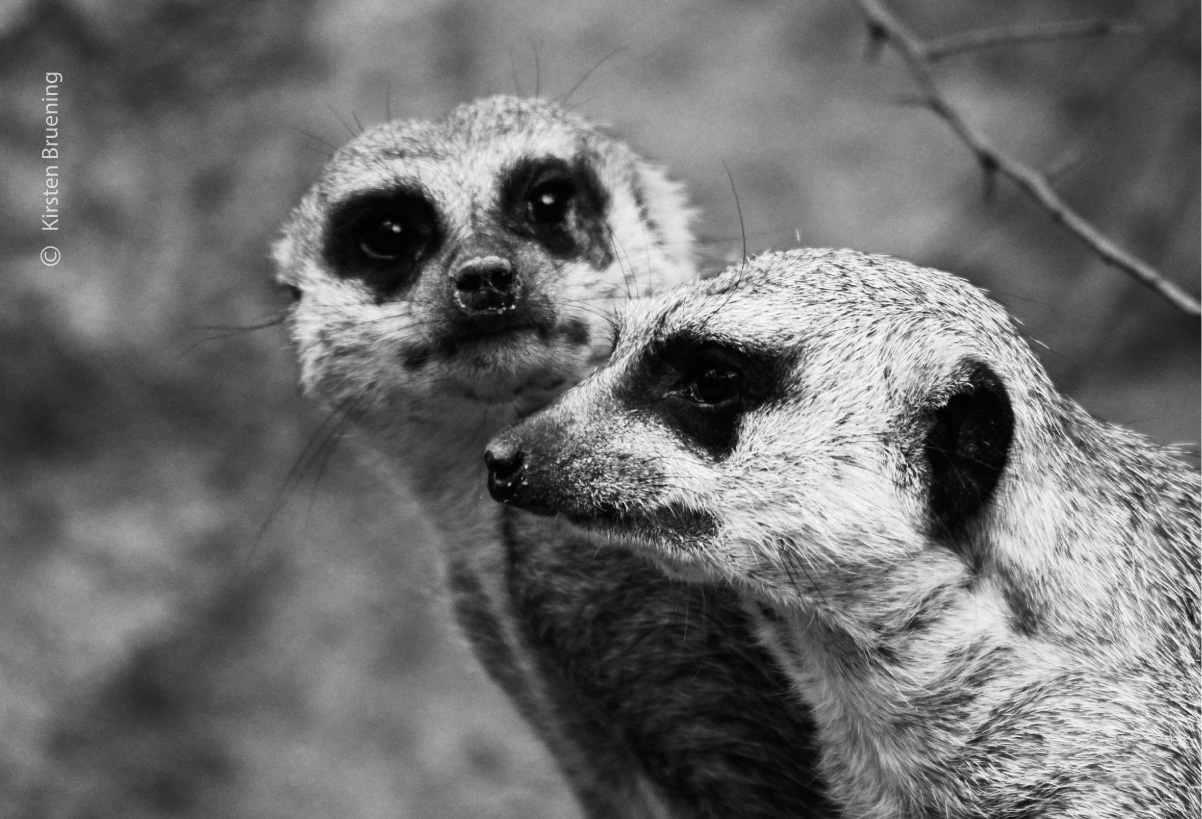
Exposure 1/1250sec @ f/5.6 | ISO 640 | Focal Length 300mm
Kirsten Bruening
Based near Cologne, Germany, Kirsten Bruening is a dedicated photographer whose creative journey began in childhood with an exploration of analogue techniques. After a fifteen-year hiatus, she returned to the craft with a renewed focus on nature, portraiture, and wildlife, often favoring the expressive power of black and white imagery. Currently pursuing formal studies to further refine her technical expertise, she remains committed to capturing the interplay of light and shadow in the natural world.
Resonance Score Breakdown
Transparency Note: The resonance score (11.5/20) is calculated based on social engagement metrics collected before the award announcement.
Expert Photography Reviews · 5
The Architecture of Vigilance
To stand guard is to hold the horizon in one’s eyes, a silent pact made with the earth beneath our feet. We are rarely so still.
Read the reflection →The Weight of Watching
It is 3:14 am. The house is holding its breath, and I am sitting in the dark, wondering about the instinct to stand guard. We spend our lives looking for threats that haven't arrived yet, scanning the horizon for a shadow that might never move.
Read the reflection →Reviews & Comments
Share your thoughts about this award-winning photograph. Your reviews contribute to the community engagement score.
Cologne Zoo’s meerkats look adorable, but I’m unsettled by how we consume their vigilance as entertainment. Bruening isolates them with a 300mm lens, stripping away the cage to manufacture a wildness that doesn’t exist here. Why do we crave this illusion of untamed nature? It feels dishonest to frame a captive animal as a free sentinel. Does our desire for these charming portraits justify the erasure of their confinement? I find the artifice here deeply uncomfortable.
The vertical axis here is defined by three distinct, parallel vectors. Bruening has solved the spatial problem by placing the meerkats in a 1:2:1 ratio across the horizontal plane, creating a rhythmic, repeating sequence. It’s a perfect geometric progression. I’m genuinely charmed by how the negative space in the upper quadrant balances their rigid, upright posture. It’s not just wildlife; it’s a calculated arrangement of mass that turns a simple zoo observation into a rigorous, satisfying equation.
The vertical alignment of the meerkats creates a rigid, repetitive geometry that anchors the frame. It’s a disciplined study of mass against a neutralized background. The negative space doesn’t distract; it isolates the subjects into a singular, sharp fulcrum. I’ve grown weary of wildlife sentimentality, but the structural precision here is undeniable. The composition holds its own weight. It’s a rare instance where the frame’s architecture justifies the subject’s presence without relying on mere charm.
There’s a profound stillness in their posture, a shared vigilance that transcends the zoo’s fence. I’ve spent hours waiting for such quiet alertness in the wild. Kirsten caught them in that soft, diffused light where the world seems to hold its breath. It’s not just a portrait; it’s a meditation on communal trust. Looking at their small, focused faces, I feel a sudden, sharp ache for the desert silence they must surely dream of.
These meerkats are sharp, sure, but they’re just subjects in a cage. There’s no conversation here, no invitation. I’ve spent my life looking for the flicker of recognition that happens when a subject lets you in, but these little guards are just doing their job for the zoo. It’s technically clean, but it leaves me cold. I want to see a life, not just a species. It’s a capture, not a gift.