
The Weight of Transit
In the nineteenth century, the arrival of the railway was often described as the shrinking of the world. It was a mechanical triumph, a way to fold distance until the far-flung felt like the near-at-hand. Yet, there is a curious paradox in the transit hub: the more we accelerate our movement, the more we seem to require moments of absolute stillness to anchor ourselves. We pass through these grand, echoing halls of departure and arrival, surrounded by the frantic energy of thousands, and yet, we are often most ourselves when we are waiting. It is in the pause between the ticket and the destination that the mask slips. We are not travelers then; we are simply people, suspended in the amber of a station’s hum, carrying our histories in the lines of our faces and the set of our shoulders. We are waiting for the next movement, but for a heartbeat, we are perfectly, achingly stationary. Does the station hold our stories, or do we simply leave them behind on the platform like discarded luggage?
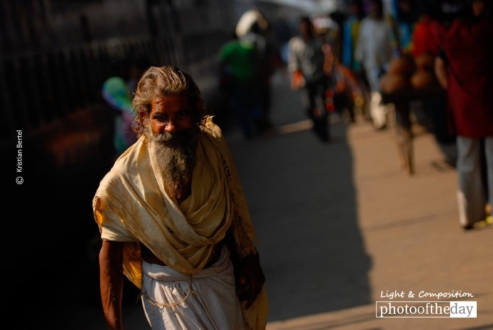
Kristian Bertel has captured this profound stillness in his work titled A Man in Varanasi. He reminds us that even in the most chaotic transit, there is a singular, quiet humanity waiting to be seen. How do you find your own center when the world around you is rushing toward the next departure?