The Unseen Borders
We often speak of the city as a human construct, a grid of concrete and commerce designed to facilitate our movement and our labor. Yet, we forget that the city is merely a thin layer of occupation draped over a much older, more persistent geography. Every patch of soil, every thicket of undergrowth, and every hidden corner of the forest floor exists in a state of quiet negotiation with the encroaching urban sprawl. We designate spaces as ‘wild’ or ‘natural’ to separate them from the places where we live, but this is a convenient fiction. The boundaries we draw are invisible to those who do not recognize our maps. When we clear land for industry or housing, we are not just building; we are displacing a complex, non-human society that has its own patterns of residency and survival. If we consider the city as a document of our priorities, what does it say about us that we only value the inhabitants who can be easily seen or easily managed? Who truly owns the ground beneath our feet?
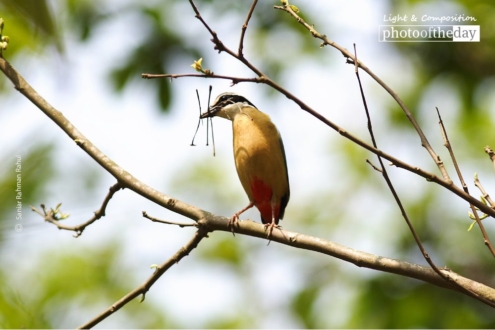
Saniar Rahman Rahul has captured this beautiful image titled Pitta Brachyuran. It serves as a reminder of the life that persists in the shadows of our development. Does this encounter change how you view the edges of your own neighborhood?