The Geometry of Transit
There is a peculiar rhythm to the way we navigate the edges of water. Cities built against the sea are never truly static; they are perpetually caught in a state of departure or arrival, a constant folding of land into the infinite blue. We often think of transit as a means to an end, a necessary friction between where we are and where we intend to be. Yet, if one stands high enough, the frantic pulse of the crowd dissolves into something more deliberate, almost geometric. It is a dance of lines and shadows, where the individual becomes a mere mark on a larger map. We are all, in our own way, navigating these currents, tracing paths that have been worn smooth by those who stood in the same spot a century ago. Does the water remember the wake of the ships, or does it simply wait for the next ripple to define its surface?
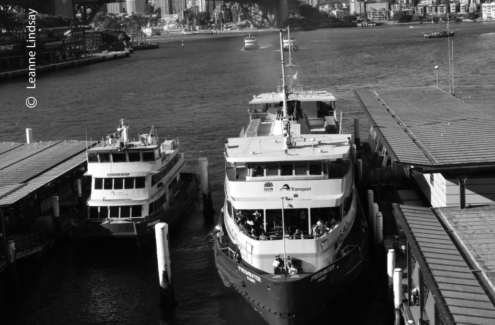
Leanne Lindsay has captured this rhythmic pulse in her work titled Circular Quay. She invites us to look down upon the intersection of city and tide, finding a strange, quiet order in the movement of the day. How does it feel to see your own world from such a distance?