
The Architecture of Devotion
We often mistake the city for a collection of static objects—walls, roads, and infrastructure—but a city is truly defined by the movement of bodies within it. Every path worn into the earth or paved in stone is a record of a ritual. Some rituals are secular, dictated by the clock and the commute, while others are ancient, tethered to a rhythm that predates the modern grid. When a person moves through a space with a singular, quiet purpose, they temporarily rewrite the geography of that place. They transform a thoroughfare into a sanctuary, if only for the duration of their stride. It forces us to consider the invisible boundaries we maintain between the sacred and the mundane. Who is permitted to occupy the center of the street, and who is relegated to the edges? When we observe a life lived in accordance with a tradition that demands humility, we are forced to confront the noise of our own frantic, consumption-driven urban existence. Is the city a place for us to simply pass through, or is it a vessel for our deepest commitments?
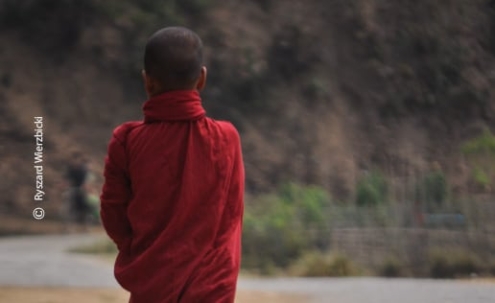
Ryszard Wierzbicki has captured this quiet intersection of tradition and daily life in his image titled The Monk’s Path. It serves as a reminder that even in the most familiar streets, there are layers of meaning we often overlook. Does this image change how you perceive the rhythm of your own neighborhood?