Expedition Overview
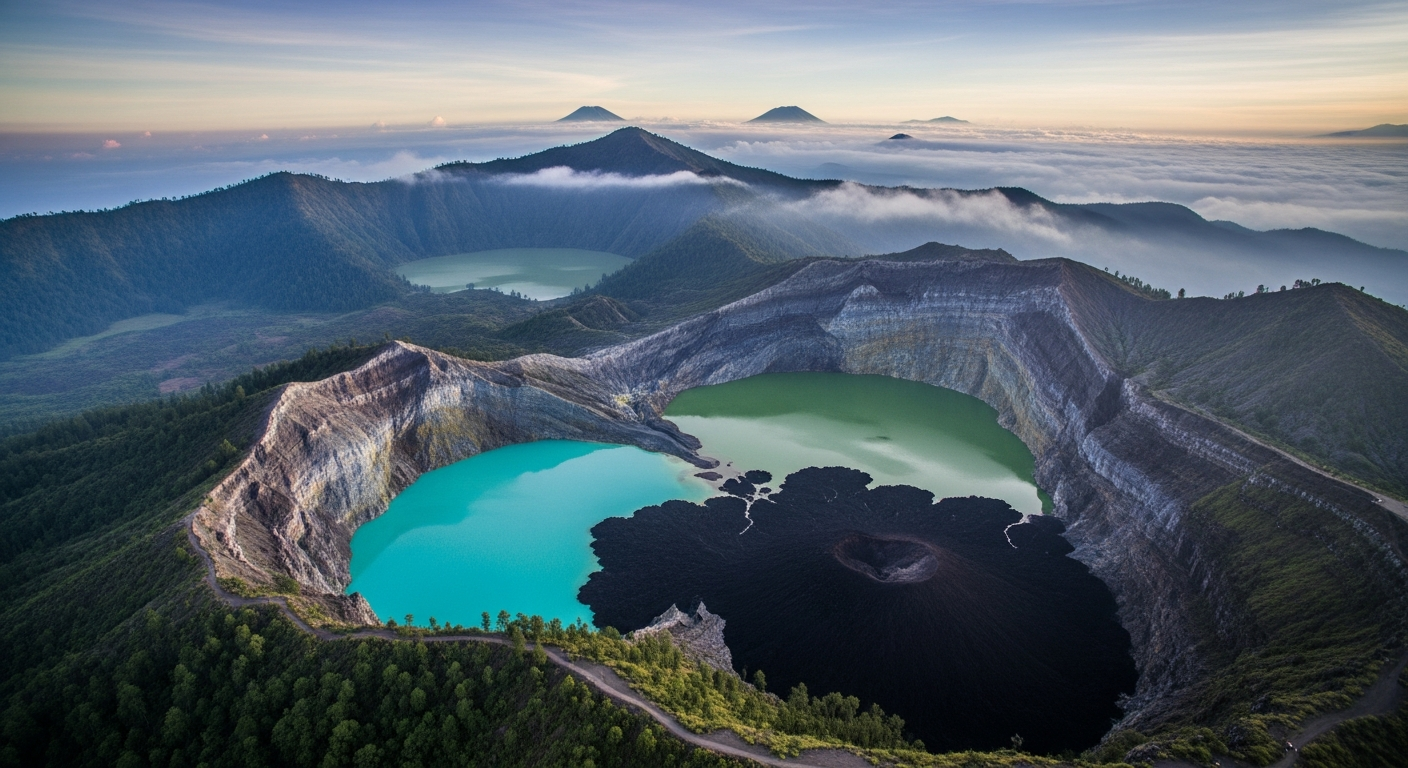
Flores is one of Indonesia's most underrated islands — a 360km-long volcanic spine running east to west, with each district maintaining distinct languages, architecture, and cultures that reflect its complex history of settlement. At its centre is Kelimutu, the volcanic crater lake complex where three separate lakes of different colours — emerald green, turquoise, and black — sit side by side in a single caldera. In the west, Wae Rebo is an isolated Manggarai village accessible only by a 3-hour mountain jungle trek, where cone-shaped traditional houses (mbaru niang) have been preserved and revived by the community.
Professor Nasrul Eam treats Flores as an island that rewards slow travel and genuine engagement — the photographs that come from Wae Rebo, where the village council receives you as a guest and the homestay experience is entirely authentic, are fundamentally different from the quick-stop tourist visit.
Expedition Itinerary
Day 1: Kelimutu — The Colour-Shifting Lakes
Pre-dawn drive to the Kelimutu summit (1639m). Sunrise at the rim reveals three lakes in different colours — a chemical result of varying mineral concentrations. The colours shift seasonally and year-to-year: teal, turquoise, black, brown, green. Morning fog in the valleys below.
The Goal of the Day: Volcanic lake colour photography at dawn; the science of colour in landscape.
Day 2: Bajawa Ngada Villages
The Bajawa highlands are home to the Ngada people, who maintain an animist tradition alongside Christianity. Their villages contain ngadhu (thatched parasol shrines) and bhaga (miniature houses), the male and female spiritual houses of the clan. Market day in Bajawa is one of the most colourful in eastern Indonesia.
The Goal of the Day: Animist cultural documentation; the visual vocabulary of a non-mainstream tradition.
Day 3: Trek to Wae Rebo
3-hour jungle trek from Denge village up through cloud forest to Wae Rebo at 1200m. The community has received the UNESCO Asia-Pacific Award for Cultural Heritage Conservation for its revival of the mbaru niang houses. Overnight homestay in the village.
The Goal of the Day: Remote village documentation; the mbaru niang architecture that exists nowhere else.
Day 4: Wae Rebo Morning & Return
Dawn in the village — smoke from the fires in the cone houses, the community beginning the day. The morning photography of the houses against the cloud forest is among the finest things to photograph in eastern Indonesia. Return trek.
The Goal of the Day: Morning community life; the dawn quality of an isolated mountain village.
Day 5: Riung Islands & Return to Labuan Bajo
The Riung "17 Islands" marine park on the north coast has coral reefs, sea turtles, and the rare flying foxes (fruit bats) roosting by the thousands in the island trees. Return westward to Labuan Bajo for the flight out.
The Goal of the Day: Marine park photography; the flying fox roost as a wildlife spectacle.
Book Your Expedition
Note: Final price may vary based on specific expedition details and customizations.
Expedition Leaders
Professor Nasrul Eam is a seasoned explorer and visual storyteller who has spent over two decades traversing Asia’s diverse landscapes and cultures. As Dean of the Department of Art and Photography at Light & Composition University, he leads immersive photography expeditions to regions like the Himalayas, Sundarbans, and Bali. These journeys blend cultural exploration with hands-on learning, culminating in a complete photography diploma. With a portfolio of over 50 publications—including The Quintessence of Photography and Illuminating Nature—his work captures the profound beauty of everyday life. His background in advertising, linguistics, and visual arts enriches his mentorship, guiding participants to uncover compelling narratives through their lenses. Professor Eam’s expeditions are transformative experiences, inspiring photographers to engage deeply with the world around them.
Travel Information
Most participants fly Bali–Labuan Bajo and travel east by road (7 hours to Bajawa, 9 hours to Ende–Kelimutu). Alternatively fly Bali–Ende. Best season: April–November.
What to Bring
• Strong hiking footwear for the Wae Rebo trek
• Wide-angle for mbaru niang architecture
• 70–200mm for the Kelimutu lake colours
• Polarising filter for lakes
• Layers (Kelimutu at 1639m is cold at 4am)