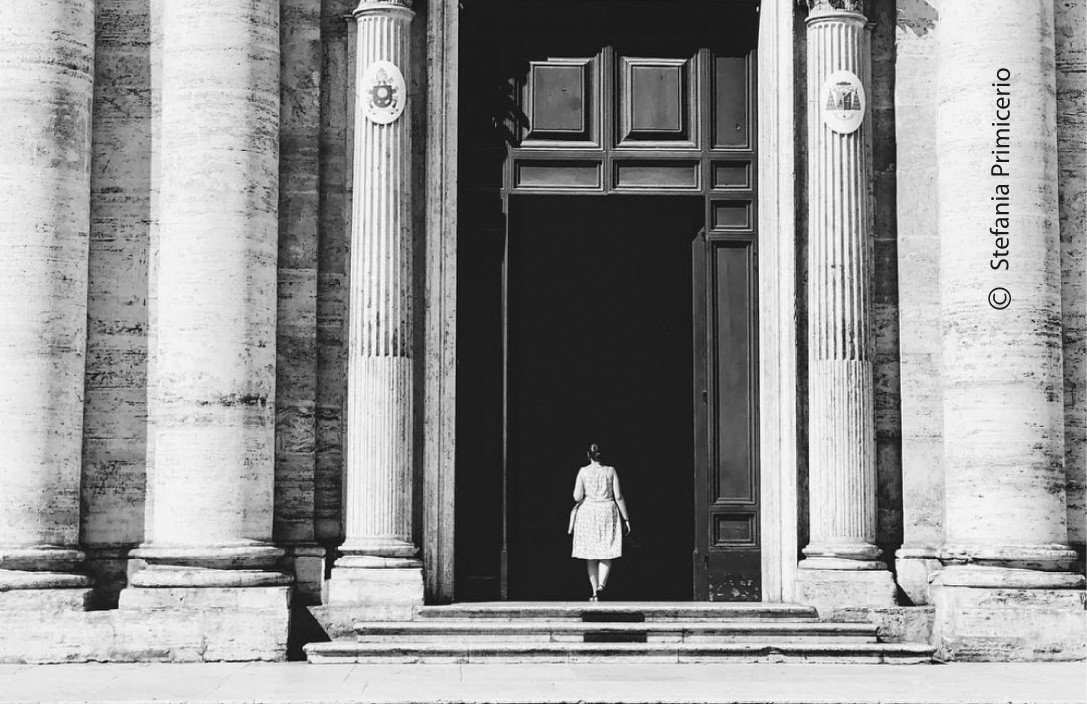
The Solitude by Stefania Primicerio
Captured within the historic walls of Santa Maria in Vallicella in Rome, this photograph masterfully balances the architectural grandeur of the church with the quiet introspection of a lone visitor. Amidst a sweltering Roman day, the photographer utilized the intense, dramatic light to isolate the subject, emphasizing the profound solitude of the moment. The image is award-worthy for its minimalist composition and its ability to transform a fleeting encounter into a timeless narrative, highlighting the stark contrast between the vast, magnificent interior and the singular human presence within it.
Stefania Primicerio
Born in Salerno in 1981, Stefania Primicerio is a Rome-based photographer and communication specialist who finds inspiration in the hidden corners and everyday rhythms of the Eternal City. Her work is defined by a keen eye for minimalist subjects, ranging from the quiet solitude of urban life to the city's feline inhabitants. Driven by a passion for discovery and global travel, she continuously refines her craft by documenting the subtle, often overlooked details that define the character of her surroundings.
Resonance Score Breakdown
Transparency Note: The resonance score (9.4/20) is calculated based on social engagement metrics collected before the award announcement.
Expert Photography Reviews · 8
The Architecture of Silence
We often mistake grand monuments for symbols of permanence, forgetting that they were built to dwarf the individual.
Read the reflection →The Weight of Quiet
I remember sitting in a small chapel in Lucca, just as the afternoon heat began to press against the heavy wooden doors. There was a woman three rows ahead of me, her head bowed, perfectly still.
Read the reflection →Reviews & Comments
Share your thoughts about this award-winning photograph. Your reviews contribute to the community engagement score.
You waited for that light to carve the silence out of the stone. It’s a heavy, sweltering day in Rome, but you found the one spot where the world stops moving. I feel a strange, quiet ache looking at that lone figure against the vastness of the church. You didn’t just frame a building; you caught a person breathing in the dark. And that’s the only truth that matters. You really felt this one, didn’t you?
Most entries in the Classic category rely on the grandeur of Rome to do the heavy lifting. They’re predictable. What separates this from the pack is the brutal restraint. By pinning that lone figure against the cavernous, sun-drenched architecture of Santa Maria in Vallicella, Primicerio forces us to confront our own insignificance. I’ve stared at this for weeks, and it still makes me feel small. That’s why it’ll matter in thirty years. It’s perfect.
Santa Maria in Vallicella swallows this visitor whole. It’s a classic Roman trope: the tiny, pious soul dwarfed by baroque excess. But why must we aestheticize someone’s private prayer for a minimalist frame? Does the iPhone’s clinical sharpness strip away the subject’s humanity, turning a moment of devotion into a mere geometric prop? I feel a sharp pang of intrusion here. We’ve commodified her solitude for a clean composition. Is this reverence, or just voyeurism in high contrast?
The subject’s stride is caught mid-transition, but the timing is off. The weight hasn’t fully shifted to the lead leg, leaving the posture slightly hesitant rather than decisive. It’s a near miss. I’ve spent my life chasing that singular, explosive millisecond where the body commits entirely to the movement. Here, the shutter clicked a fraction too late. It’s technically clean, sure, but it lacks the kinetic snap that makes a human body truly come alive.
Before the eye identifies the Roman architecture, something in the chest hitches. It’s the sudden, cool silence of Santa Maria in Vallicella pressing against the skin. That lone figure isn’t just a subject; they’re an anchor for my own restlessness. When I return to this frame, I still feel that sharp, rhythmic pull of the shadows. It’s a quiet ache I’ve carried since I first saw it—a reminder of how small we are in the light.
The stone floor stretches. It’s a vast, cold sea. A single figure sits, anchored by the weight of the architecture. The light doesn’t touch them; it defines them. I’ve stood in these Roman shadows, and I recognize the ache of this stillness. Nothing here is accidental. The empty corner is not empty. It’s a breath held in the dark. It’s the silence I’ve been searching for. It’s enough.
The architecture dictates the terms here. The heavy, vertical lines of the nave compress the subject into a singular, fragile fulcrum. It’s a brutal geometry. The negative space doesn’t just surround; it consumes. I’ve rarely seen such a cold, precise isolation of a human form against stone. The frame holds because the light is disciplined, not decorative. It’s a rare instance where the structure doesn’t just support the narrative—it demands it.
1/420sec at f/2, ISO 25, 6mm. The iPhone 12 Pro sensor is tiny, yet Primicerio forces it to handle extreme dynamic range. That f/2 aperture creates a shallow plane that isolates the subject against the heavy Roman architecture. It’s a calculated risk. I’ve spent years staring at sensors, and frankly, the way this light hits the stone without clipping the highlights is impressive. She didn’t just snap a picture; she engineered a moment of silence.