The Church Keeper by Rasha Rashad
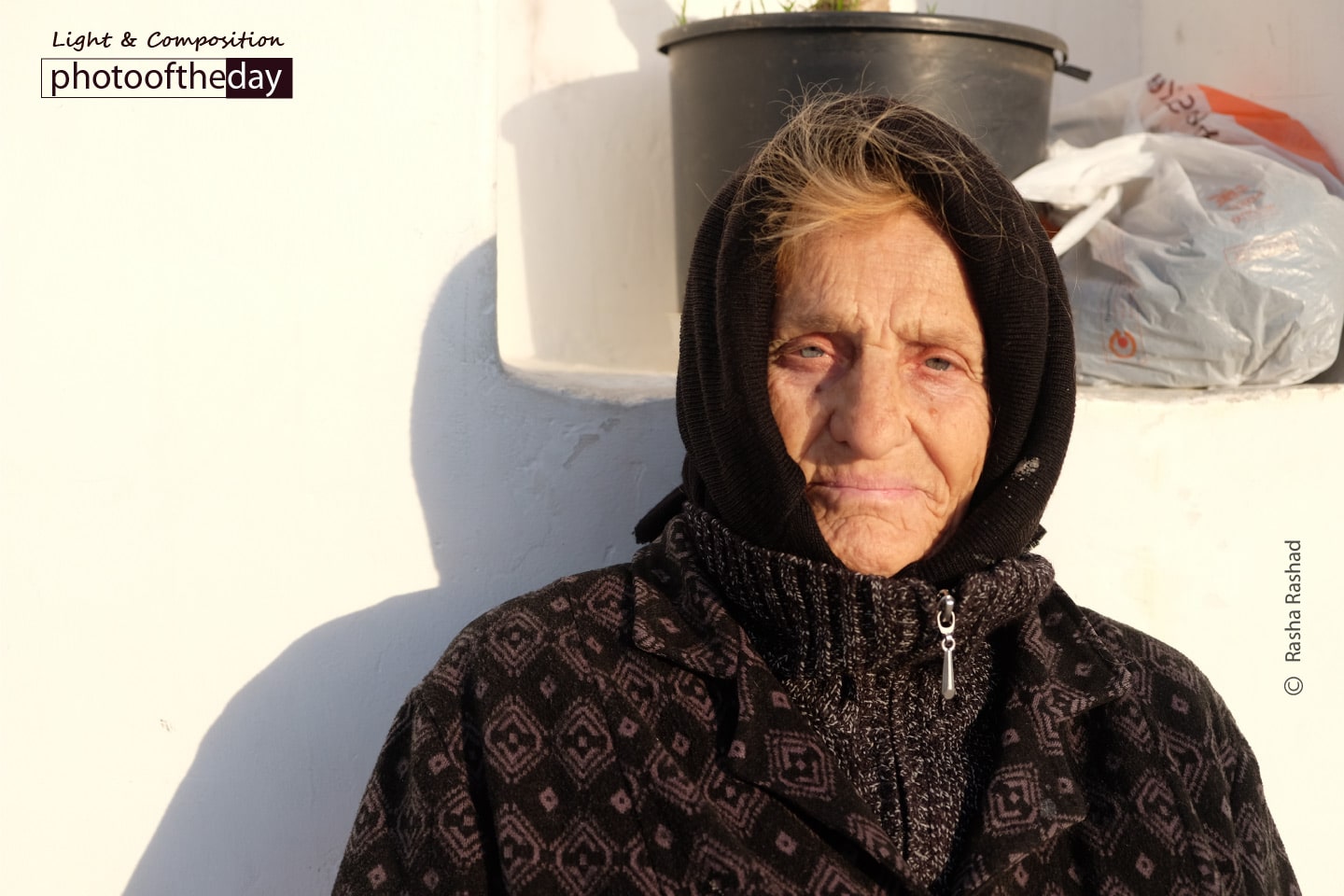
Captured on a sun-drenched afternoon at Lycabettus Mount in Athens, this portrait reveals the profound character of a church keeper. The photographer initially engaged the subject with a compliment, eliciting a joyful smile, but as the woman settled into a pose, her expression shifted into a contemplative state. This transition allowed the camera to document the intricate map of wrinkles that tell a story of age and lived experience. The image is award-worthy for its raw, authentic portrayal of human emotion and the photographer’s ability to bridge the gap between a fleeting moment of laughter and the enduring depth of a person’s history.
Rasha Rashad
Hailing from Alexandria, Egypt, Rasha Rashad is a dedicated wanderer and explorer with a deep passion for discovering new cultures and people. After transitioning away from a corporate career to pursue photography full-time, she has focused her creative lens on the nuances of street photography and food. Her work is heavily influenced by her love for literature and classic black and white cinema, which informs the evocative, narrative quality of her portraiture.
Resonance Score Breakdown
Transparency Note: The resonance score (12.3/20) is calculated based on social engagement metrics collected before the award announcement.
Expert Photography Reviews · 4
The Weight of Afternoon
There is a specific quality to the light in the middle of a long afternoon, when the sun has lost its morning urgency but has not yet begun the slow, bruised surrender of the evening.
Read the reflection →The Cartography of Time
When a tree reaches a certain age, its bark begins to fissure, creating deep, intersecting channels that map the history of every drought, every harsh winter, and every season of abundance the forest has endured.
Read the reflection →Reviews & Comments
Share your thoughts about this award-winning photograph. Your reviews contribute to the community engagement score.
The light hits the stone wall behind her. It’s a vast, pale void. She sits in the corner, small against the expanse. I’ve spent minutes just watching the shadow trace her jaw. It’s quiet. The wrinkles aren’t just age; they’re a map of stillness. I feel a sudden, sharp ache in my chest looking at her hands. Nothing here is accidental. The empty corner is not empty. It’s the breath between heartbeats. It’s enough.
Before the eye identifies the church keeper, a sudden stillness settles in the chest. It’s the weight of those deep, etched lines that catches me; I feel my own face soften in sympathy. Rashad captures that precise, fleeting transition from joy to solitude. When I return to this portrait a year later, the silence feels heavier, more intimate. It’s a haunting reminder that we all carry our histories in the quiet geometry of our skin.
The subject’s face occupies the frame with a brutal, tectonic density. It’s a topography of deep-set lines that anchors the entire composition. The negative space behind her doesn’t distract; it forces the eye back to the fulcrum of her gaze. I’ve rarely seen such structural honesty in a portrait. The light carves out the bone, creating a tension that holds perfectly. It’s a rigid, architectural triumph. Sentiment is irrelevant here; the geometry is everything.
The subject’s face functions as a complex coordinate plane. The vertical axis of her nose bisects the frame, while the deep, rhythmic furrows of her skin create a series of parallel vectors that pull the eye toward the negative space on the left. It’s a perfect 1:1 balance of light and shadow. I’m genuinely moved by how the geometry of her wrinkles anchors the composition. It’s not just a portrait; it’s a beautifully solved spatial equation.