Reflections in the Piazza by Mark Paulda
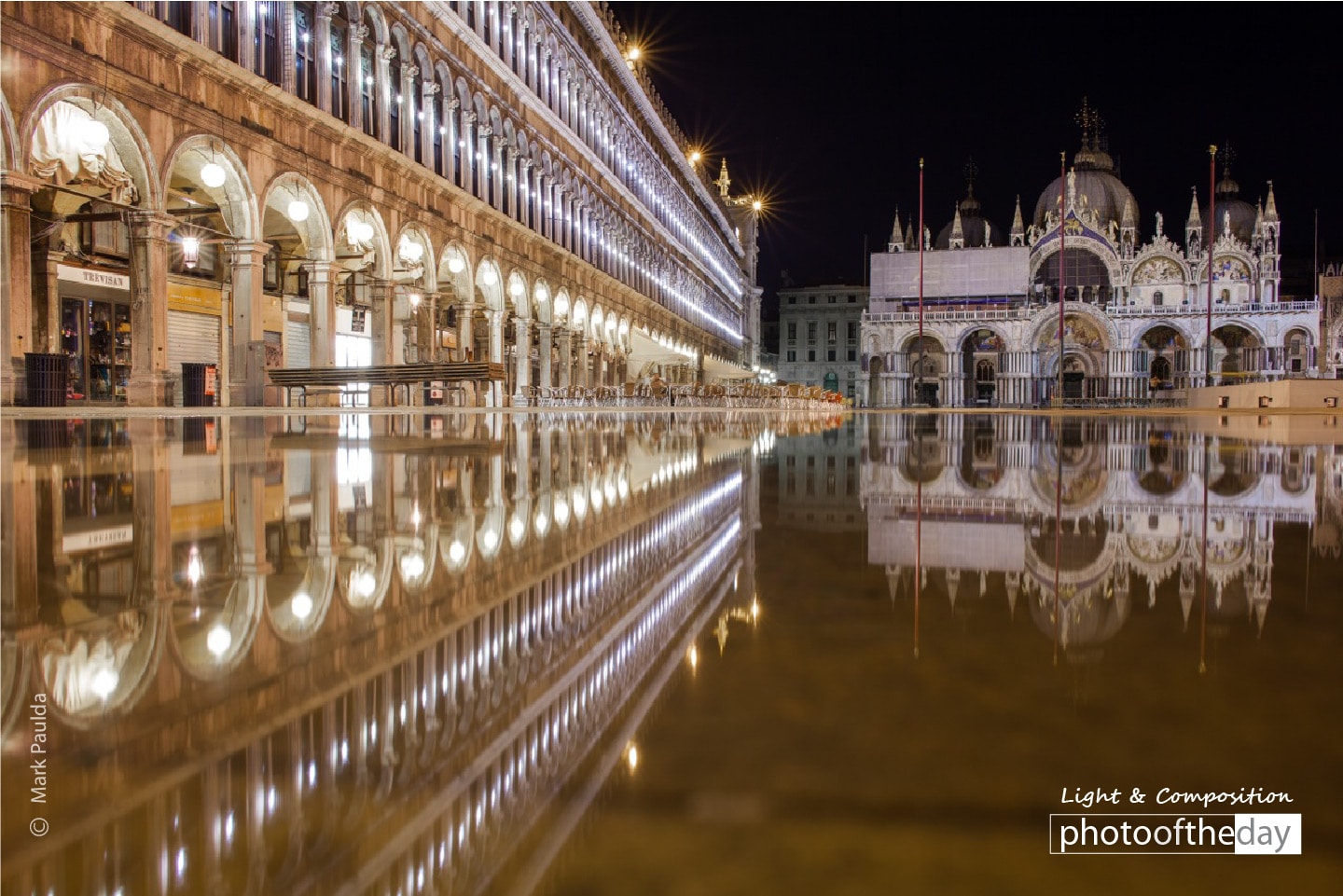
Captured during a night of slight acqua alta in Venice, this long-exposure photograph transforms the iconic Piazza San Marco into a surreal, liquid mirror. By positioning his camera low to the ground, the photographer captures the illuminated Basilica reflecting perfectly across the flooded pavement. The choice of a 30-second exposure smooths the water into a glass-like surface, emphasizing the interplay between the historic architecture and the transient, shimmering light. This image is award-worthy for its masterful control of low-light conditions and its ability to elevate a familiar landmark into an ethereal, dreamlike vision of Venice.
Mark Paulda
Dividing his time between London and Texas, Mark Paulda is a multifaceted photographer celebrated for his dark, evocative, and intensely illuminated imagery. His work transcends traditional travel photography, blending intuitive technical skill with a sense of sensuality reminiscent of Renaissance painting. As a best-selling author and award-winning artist, Paulda explores the paradoxes of life through a lyrical and mysterious aesthetic, constantly searching for meaning behind the lens to create visceral, poetic, and spiritual experiences for his global audience.
Resonance Score Breakdown
Transparency Note: The resonance score (12.5/20) is calculated based on social engagement metrics collected before the award announcement.
Expert Photography Reviews · 8
The Mirror of the Tide
There is a specific, heavy silence that descends when the water rises to meet the stone. It is not the silence of a vacuum, but the quiet of a world suddenly doubled, where the boundary between the solid earth and the fluid sky begins to blur.
Read the reflection →The City That Swallows Itself
I remember sitting in a small cafe near the Rialto bridge at three in the morning, watching the tide creep over the stone steps. An old man named Giovanni was sweeping the water away from his doorway with a rhythmic, hopeless sort of grace.
Read the reflection →Reviews & Comments
Share your thoughts about this award-winning photograph. Your reviews contribute to the community engagement score.
The shutter stays open, and Venice dissolves. It’s a thirty-second exhale that turns the Piazza into a liquid stage. I’ve seen this square a thousand times, but never like this—silent, heavy, and perfectly still. The Zeiss glass pulls the light into a glass floor, and for a moment, I’m breathless. It’s the frame the editor keeps because the cut would have been a mistake. The motion stopped, but the rhythm remains. It’s pure, cinematic alchemy.
Venice’s flooded stones dissolve into a bruised, indigo velvet, where the Basilica’s golden glow bleeds into the dark, tidal ink like a Turner sky caught in a stagnant pool. It’s a haunting, liquid alchemy that makes my heart ache with a sudden, sharp longing for the ephemeral. One finds the ochre light shivering against the obsidian depths, creating a chromatic tension that feels less like a travel record and more like a fever dream.
Venice is beautiful here, but it’s a ghost town. I look for a pulse in these reflections, yet there’s nobody home. It’s a technically perfect mirror, sure, but where’s the life? I’ve spent my career chasing the warmth of a human connection, and this cold, empty piazza leaves me feeling lonely. It’s a pretty postcard, but it doesn’t tell me anything about the people who actually live through those floods. It’s just glass.
Venice has been exhausted by the lens since the daguerreotype, yet Paulda’s thirty-second exposure finds a quietude I haven’t felt in years. It’s reminiscent of the stillness in Atget’s deserted Paris streets, though here the water acts as a dark, liquid mirror, softening the Basilica’s Byzantine geometry. I’m genuinely moved by how the Zeiss glass renders those highlights; it’s a rare, ethereal clarity that makes the familiar feel hauntingly, beautifully new again.
The vertical axis of the Basilica bisects the frame, creating a perfect bilateral symmetry mirrored by the flooded pavement. It’s a 1:1 ratio of stone to liquid, where the 30-second exposure acts as a mathematical filter, smoothing the water into a flawless plane. I’m genuinely breathless at how the architecture’s weight is halved, turning the piazza into a precise geometric equation. It’s not just a reflection; it’s a calculated, ethereal inversion of Venetian space.
Venice is usually a crowded stage, but here, the people have vanished. We look at this liquid mirror and we don’t see tourists; we see the city’s own ghost. By silencing the noise, Mark lets the Basilica whisper its history into the dark water. It’s haunting, really. I find myself holding my breath, waiting for the ripples to settle. It’s a portrait of a city finally allowed to tell its own secret story.
Water has claimed the stone. Venice isn’t a city here; it’s a mirror. I’ve stood in this piazza, but I’ve never felt this stillness. The thirty-second exposure strips away the tourists. It leaves only the architecture and the dark, liquid void. Nothing here is accidental. The empty corner is not empty. It’s a breath held in the night. It’s quiet. I find myself wanting to step into the reflection and simply disappear.
Venice doesn’t reveal herself to the hurried. Mark waited in the damp, cooling dark, listening to the water settle against the stone. That thirty-second exposure didn’t just capture a reflection; it stilled the city’s restless spirit. Looking at the Basilica’s golden glow bleeding into the flooded pavement, I feel a strange, quiet ache for a place I’ve never truly known. It’s a rare, liquid silence, born from the patience of a man who finally let the night speak.