Arranging Stock by Siew Bee Lim
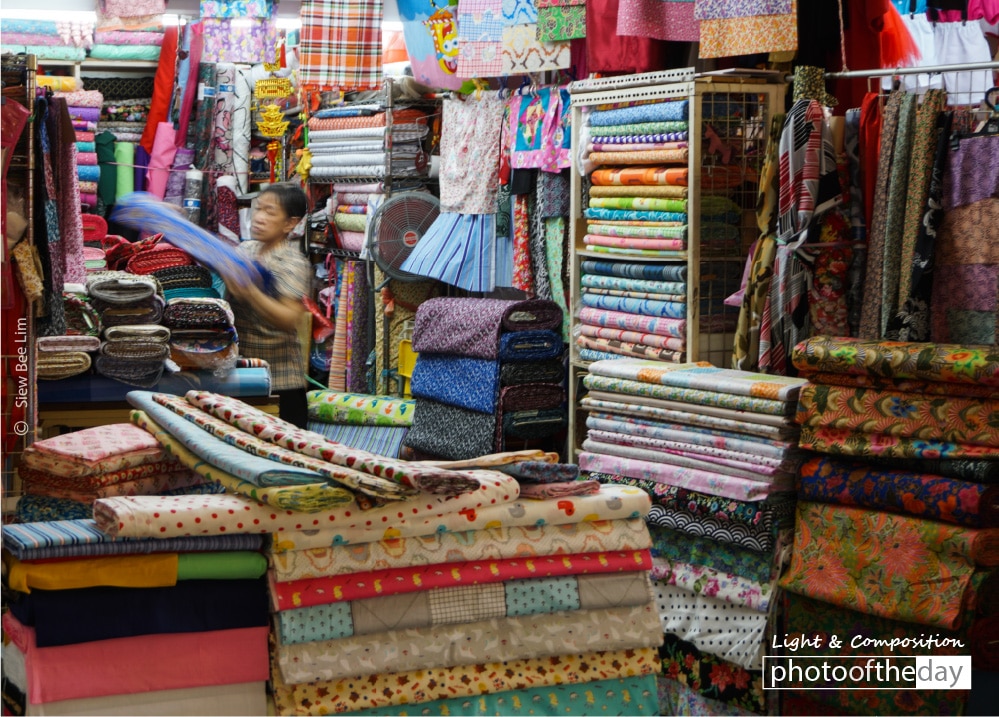
During a weekend assignment focused on color, the photographer visited the vibrant China Town Complex in Singapore. Seeking out vivid subjects, she encountered a store owner meticulously arranging her stock to prepare for the day's business. After securing permission, the photographer captured the scene, eventually stepping back to frame the entire storefront within the context of its bustling environment. This image is award-worthy for its authentic portrayal of daily life, demonstrating a keen eye for color and a respectful approach to street portraiture that captures a quiet, human moment amidst the urban landscape.
Siew Bee Lim
Born in 1965 in Singapore, Siew Bee Lim has long nurtured a passion for the art of photography. Currently refining her craft through the Light & Composition platform, she demonstrates a dedicated commitment to formalizing her skills and evolving her creative vision. Her work reflects a thoughtful engagement with her surroundings, capturing the essence of local life with a growing technical proficiency and an observant, artistic eye.
Resonance Score Breakdown
Transparency Note: The resonance score (11.9/20) is calculated based on social engagement metrics collected before the award announcement.
Expert Photography Reviews · 8
The Rhythm of Hands
There is a quiet holiness in the way we prepare for the day. Before the world rushes in with its demands and its noise, there is a small, sacred window of time where we set things in order.
Read the reflection →The Quiet Before the Rush
I spent this morning tidying my bookshelf, moving things just an inch to the left or right until they felt settled. It wasn't about the books themselves, but about the rhythm of the act.
Read the reflection →Reviews & Comments
Share your thoughts about this award-winning photograph. Your reviews contribute to the community engagement score.

The light here doesn’t shout; it hums against the plastic containers and vibrant goods. She stood in the quiet hum of the morning, waiting for the shopkeeper’s rhythm to align with the frame. I’ve felt that same stillness, that breath held before the shutter clicks. It’s a rare, honest grace. Watching her arrange those small, colorful lives, I feel a sudden, sharp ache for the simple dignity of work. It’s a beautiful, patient observation.
We walk through the heat of Singapore’s Chinatown and find her. She isn’t just stacking goods; she’s whispering to the rhythm of her trade. Siew Bee Lim didn’t just snap a shutter; she waited until the woman’s hands found their own quiet grace. I feel a sudden, sharp nostalgia for my grandmother’s market stall. It’s a rare, honest conversation between lens and life. This is a photograph that asks to be returned to, again and again.
The ochre of the hanging lanterns bleeds into the shop’s shadows, creating a chromatic friction that reminds me of Morandi’s dust-choked still lifes, yet it’s the sudden, sharp intrusion of that synthetic, electric-blue plastic crate that truly undoes me. It’s a jarring, beautiful dissonance, a violent splash of cold water against the warm, sun-drenched humidity of the Singaporean morning, and I’ve found myself quite breathless, caught in the quiet, aching tension of such an unexpected, vivid harmony.
At 1/6th of a second, Lim nudges the frame toward a kinetic blur that feels far more honest than a frozen snapshot. It’s a rhythmic, painterly smear of Chinatown’s chaos. I’m genuinely moved by how the motion softens the stock’s edges, turning commerce into a ghost of daily labor. Why resolve the details when the blur captures the heat? This approach is closer to Sugimoto’s long-exposure theatres than to conventional, sterile street photography. It’s wonderfully alive.
Most street photography in Singapore is cluttered, but Lim’s frame breathes. The deliberate geometry of those stacked goods anchors the chaos of the Chinatown Complex. It’s the restraint that wins here; she didn’t crowd the subject, letting the vibrant color palette do the heavy lifting. I’ve seen thousands of market shots, but this one feels like a quiet, honest exhale. In thirty years, we’ll still want to remember how this shopkeeper’s hands moved.
Before the eye identifies the shelves, a sudden stillness settles in the chest. It’s the rhythm of the shopkeeper’s hands that anchors me; they move with a quiet, repetitive grace that slows my own pulse. I’ve returned to this frame three times today, and each time, the vibrant, saturated reds pull me back into that humid Singaporean morning. It’s a rare, grounding comfort—a reminder that even in the city’s rush, someone is still tending to the small things.
It’s refreshing to see a frame where the subject’s agency remains intact. In my field, we’re often guilty of forcing proximity, but here, the photographer waited for the shopkeeper’s permission before retreating. That distance feels honest. It’s a quiet, human moment that doesn’t feel extracted or stolen. I’ve spent weeks in blinds waiting for a bird to trust me; seeing that same restraint applied to a street portrait makes me genuinely smile. It’s earned, not taken.
The shutter speed drags, blurring the frantic pulse of Singapore into a soft, kinetic hum. It’s a masterclass in stillness. The shopkeeper’s hands move with a rhythm that feels like a slow-motion sequence in a documentary. I’m struck by the warmth of those reds; they anchor the frame while the world rushes past. It’s the shot the editor keeps because it breathes. You don’t cut away from a moment this honest. It’s perfect.