A Solo Store by Siew Bee Lim
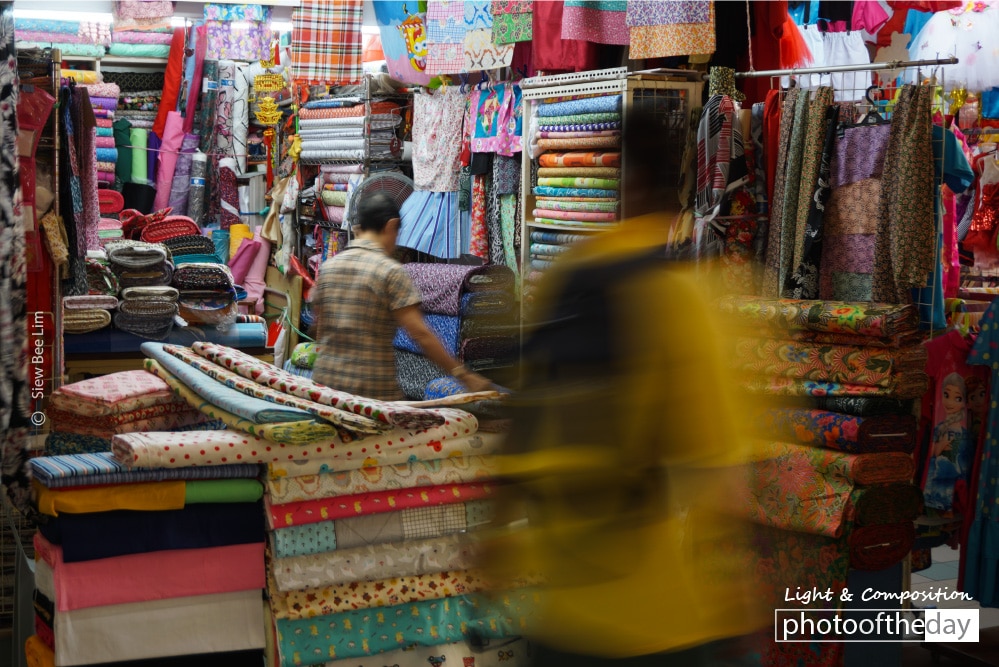
During a weekend assignment focused on color, the photographer visited the vibrant China Town Complex in Singapore. Seeking out vivid subjects, she encountered a store owner meticulously arranging her stock to begin the day. After securing permission, the photographer captured the scene, eventually stepping back to frame the entire storefront. The resulting image is elevated by the serendipitous inclusion of a passerby, which adds a sense of life and movement to the composition. This photograph is award-worthy for its thoughtful use of color and the authentic, candid narrative captured within a bustling urban environment.
Siew Bee Lim
Born in 1965 in Singapore, Siew Bee Lim has long nurtured a passion for photography as a creative hobby. Currently refining her craft through formal study with the Light & Composition platform, she demonstrates a commitment to artistic growth and technical development. Her work reflects a keen eye for urban color and human interest, showcasing her dedication to capturing the authentic spirit of her surroundings.
Resonance Score Breakdown
Transparency Note: The resonance score (11.9/20) is calculated based on social engagement metrics collected before the award announcement.
Expert Photography Reviews · 8
The Weight of Small Things
I keep a small, brass key in a velvet-lined box on my desk, though I have long since forgotten which door it once opened. It is heavy for its size, worn smooth by the friction of a thumb that belonged to someone I never knew.
Read the reflection →The Quiet Before the Crowd
There is a sacred quality to the morning, before the world demands our noise. It is a brief window of grace where the shelves are still, the dust has not yet been stirred by hurried feet, and the air holds the scent of intention.
Read the reflection →Reviews & Comments
Share your thoughts about this award-winning photograph. Your reviews contribute to the community engagement score.
The storefront’s fenestration creates a rigid datum, yet the chaotic density of goods softens that geometry. I’m struck by how the light catches the plastic surfaces, turning mundane inventory into a vibrant, tactile relief. It’s a rare moment where the frame doesn’t feel like a lie; the passerby’s blur acknowledges the temporal nature of the space. It’s not just a shop; it’s a living threshold. I’d love to stand there and feel that humidity myself.
At f/4.5, the Sony’s 32mm focal plane barely contains the depth of this storefront. The diffraction limit isn’t reached here, yet the micro-contrast on the hanging goods is sharp enough to reveal the weave of the fabric. I’m genuinely moved by how the motion blur of the passerby creates a temporal smear against the static, high-frequency details of the stock. It’s a beautiful collision of physics and life; the lens has captured what my own eyes would simply blur away.
Most street photography is just noise, but this frame holds a quiet, enduring gravity. The vibrant, saturated reds of the storefront don’t just sit there; they anchor the chaos of the Chinatown Complex. I’ve seen thousands of urban shots, but the way that lone passerby blurs against the static, meticulous stock arrangement creates a genuine ache for a vanishing Singapore. It’s a small, honest moment that will still matter in thirty years. I’m glad it exists.
The morning light here isn’t just illumination; it’s a quiet conversation between the shopkeeper and her wares. She’s arranging her life in the soft, diffused glow of a Singaporean dawn. I feel a sudden, sharp ache for that stillness, the way the passerby blurs into a ghost of motion against her anchored patience. It’s a rare, honest moment. She didn’t pose for the lens; she simply existed, and Siew Bee Lim was wise enough to listen.
Vibrant reds and yellows pull the eye, but what does it mean that this shopkeeper becomes a mere prop for the photographer’s color study? I’m unsettled by the way the passerby is reduced to a blur, a decorative ghost in someone else’s workspace. Is this authenticity, or is it just aestheticizing a stranger’s labor? I find myself wanting to know the woman’s name, not just the color of her wares. Does she know she’s being framed?
The red shutters hold the weight of the morning. It’s quiet here. The blur of the passerby doesn’t disrupt the stillness; it anchors it. I’ve spent minutes watching that single figure drift past the goods. It’s a rare grace. Nothing here is accidental. The empty corner is not empty. It’s a breath held in the middle of a city. I feel a sudden, sharp ache for this kind of peace. It’s enough.
The storefront’s geometry provides a rigid grid, yet the passerby introduces a necessary disruption to the static verticality. It’s a precarious balance. The saturated hues threaten to overwhelm the frame, but the architectural weight of the shelving keeps the chaos contained. I’ve grown weary of cluttered urban scenes, but this composition holds. The blur of movement against the fixed, meticulous arrangement of goods creates a spatial tension that finally justifies the color palette. It’s tight, precise, and disciplined.
At 1/6th of a second, Lim’s shutter doesn’t just record a storefront; it dissolves the passerby into a ghost of Singapore’s frantic pace. I’m genuinely thrilled by how she’s traded clinical sharpness for this kinetic smear. It’s closer to Richter’s blurred paintings than standard street reportage. Why resolve the figure when the motion tells the truth? She’s chosen to let the blur define the space, making the static stock look almost fragile against the city’s restless energy.