Spirit by Shirren Lim
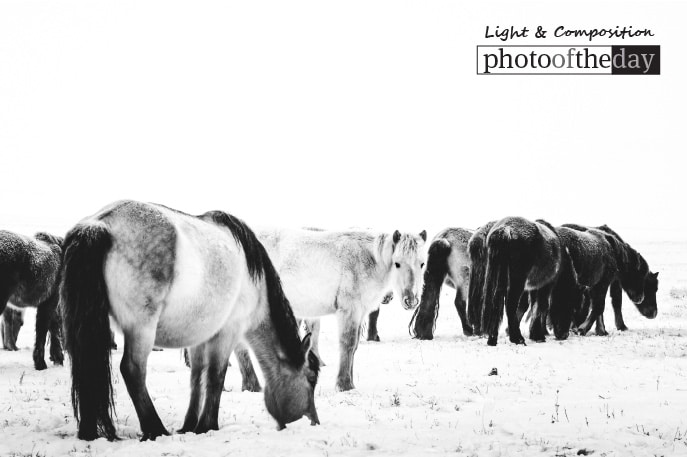
During a journey through the vast, whitewashed landscapes of Mongolia, the photographer encountered a group of wild horses grazing near the highway. Recognizing the potential for a compelling image, she approached the herd with patience and silence, waiting for the perfect moment of connection. The resulting photograph captures a singular, intimate gaze from one of the horses, highlighting the raw beauty of the animal against the stark, expansive terrain. The image is award-worthy for its masterful composition and the photographer's ability to transform a spontaneous roadside stop into a poignant, soulful encounter with wildlife.
Shirren Lim
Born in Penang Island, Malaysia, in 1970, Shirren Lim is a Jakarta-based photographer who discovered her true passion for the craft in 2009. While she specializes in portraiture, seeking to capture the sincere and uncovered expressions of humanity, her work is widely recognized for its intense, earthy quality and minimalist composition. Deeply inspired by the iconic imagery of Steve McCurry, Lim strives to document moments of profound significance, aiming to create photographs that resonate on a global scale. Her evocative work has been featured in numerous international web and printed publications.
Resonance Score Breakdown
Transparency Note: The resonance score (13.3/20) is calculated based on social engagement metrics collected before the award announcement.
Expert Photography Reviews · 5
The Weight of a Gaze
I remember sitting in a roadside cafe in the high country, watching a stray dog track a car through the dust. It didn't bark or run; it just stood there, head tilted, watching the metal machine vanish into the heat haze.
Read the reflection →The Weight of a Glance
In the quiet corners of history, we find that the most profound exchanges rarely involve a single word. We are accustomed to the noise of human discourse, the constant clatter of opinions and demands that fill our days.
Read the reflection →Reviews & Comments
Share your thoughts about this award-winning photograph. Your reviews contribute to the community engagement score.
In this vast Mongolian expanse, the horse acts as a living datum, anchoring a landscape that otherwise lacks a human-scaled threshold. The light doesn’t just illuminate the coat; it defines the mass of the animal against the void of the horizon. It’s a rare, quiet geometry. I’m struck by how the frame omits the highway, forcing us to inhabit the space purely as a creature would. It’s a beautiful, lonely architecture of breath and bone.
The horse’s head occupies the frame’s right third, creating a necessary spatial tension against the vast, negative void of the Mongolian steppe. It’s a rigid geometry. The horizon line acts as a fulcrum, balancing the animal’s mass against the stark, monochromatic expanse. I’ve rarely seen such disciplined negative space. It doesn’t rely on sentiment; it relies on the frame’s architecture. The composition holds. It’s cold, precise, and entirely unforgiving. That’s why it works.
The horse’s gaze isn’t an invitation; it’s a confrontation with the void. Lim captures the animal against that blinding, bleached Mongolian expanse, yet it’s the deep, ink-stained shadows around the eye that anchor the soul. I’ve stared at this for an hour, and it’s unsettling how the darkness refuses to yield. It doesn’t just frame the beast; it consumes the light. It’s a reminder that existence is merely a brief, fragile flicker against the infinite.
The horizon vanishes. White snow meets white sky. A horse stands, tethered only by its own breath. It’s a quiet collision of animal and void. I’ve spent minutes staring at the negative space surrounding that mane. It doesn’t feel like emptiness. It feels like a lungful of cold air. Nothing here is accidental. The empty corner is not empty. It’s the silence that finally lets me breathe. I’d stay here forever if I could.
Most wildlife shots are just trophies, but this one lingers. Of the thousands I’ve reviewed, few capture that specific, heavy silence of the Mongolian steppe. The horse’s gaze isn’t just looking at the lens; it’s questioning our presence in its world. It’s the way the muted, monochromatic palette forces you to focus on that singular, dark eye. I’ve stared at it for ten minutes, and honestly, it still makes me feel like an intruder. That’s why it endures.