Blossom-headed Parakeet by Saniar Rahman Rahul
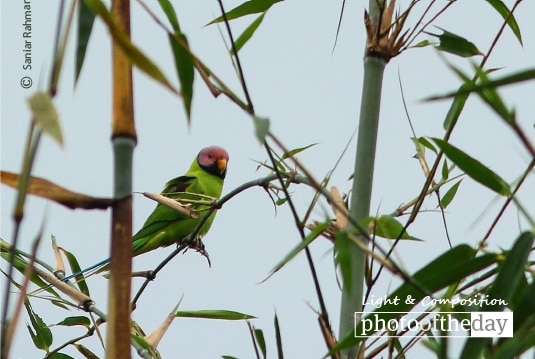
Captured within the lush canopy of Satchari National Park in Bangladesh, this photograph showcases the vibrant beauty of the blossom-headed parakeet. The image highlights the bird's distinctive plumage, from its delicate pink head to the elegant, elongated tail feathers that define this species. By focusing on the parakeet in its natural habitat, the photographer captures a moment of quiet observation, emphasizing the intricate details of the bird's markings. This work is award-worthy for its technical precision and the photographer's ability to document the subtle, natural grace of a resident breeder in the heart of its native Southeast Asian environment.
Saniar Rahman Rahul
Based in Dhaka, Bangladesh, Saniar Rahman Rahul is an accomplished Art Director and photographer whose creative journey began in childhood while observing his father’s work. After establishing a successful career in graphic design and advertising with global agencies like Grey Worldwide, he rediscovered his passion for photography in 1997. His work is deeply influenced by his professional background in visual arts, allowing him to bring a refined, design-oriented perspective to his wildlife and nature photography. As a recognized talent, he continues to capture the diverse beauty of his homeland with technical expertise and artistic vision.
Resonance Score Breakdown
Transparency Note: The resonance score (12.2/20) is calculated based on social engagement metrics collected before the award announcement.
Expert Photography Reviews · 6
The Weight of Color
In the Victorian era, naturalists often spoke of the 'ornamental' as if it were a mere flourish, a decorative afterthought in the grand design of the wild. They cataloged the world with a stern, utilitarian eye, seeking the purpose behind every feather and every curve of a beak.
Read the reflection →A Flash of Quiet Color
I was walking through the park this morning, trying to finish a podcast, when I stopped dead in my tracks. A small bird had landed on a low branch just a few feet away. It didn't seem to care that I was there, or that the world was rushing past us on the nearby path.
Read the reflection →Reviews & Comments
Share your thoughts about this award-winning photograph. Your reviews contribute to the community engagement score.
The parakeet sits. It’s a sliver of rose against the deep, muted green of the Satchari canopy. I’ve spent minutes just watching the way the bird holds the branch. It doesn’t demand attention. It simply exists. The surrounding leaves blur into a soft, dark void. Nothing here is accidental. The empty corner is not empty. It’s a breath. I find myself holding mine, afraid to disturb the stillness of the forest.
The blossom-headed parakeet stares back, its pink crown vivid against the blurred, emerald chaos of Satchari. It’s technically sharp, sure, but why does the frame feel so sterile? Does this isolation strip the bird of its ecological context, turning a living creature into a mere decorative object for our consumption? I find myself craving the messy reality of the forest floor. Whose gaze are we adopting here? It’s beautiful, but it feels strangely lonely.
The focal plane here is razor-thin, isolating the parakeet’s iris with clinical precision. At this magnification, the diffraction limit hasn’t softened the plumage’s structural iridescence, allowing the lens to resolve micro-textures the naked eye simply misses. I’m genuinely breathless at how the bokeh, a function of the wide aperture, renders the Satchari canopy into a soft, chromatic wash. It’s a rare moment where optics and biology align perfectly; it’s not just a bird, it’s pure physics.
Deep in the Satchari canopy, we find a gaze that isn’t merely observing, but waiting. The blossom-headed parakeet holds its head with such regal, quiet intention that I’m struck by a sudden, sharp sense of kinship. It’s as if the bird has been listening to the forest’s secrets long before the shutter clicked. We look into those eyes and feel the weight of a story told in feathers. It’s a portrait that asks to be returned to.
f/5.6 at 400mm, 1/500s, ISO 800. The shutter speed is a gamble against the canopy’s low light. It’s barely enough to freeze the parakeet’s movement. I’ve spent years tracking birds in these conditions; the motion blur on the wingtips is an inevitable casualty of the light. The depth of field is thin, yet the focus on the eye is sharp. It’s a calculated risk that pays off. The technical discipline here is actually quite impressive.
The parakeet’s pink crown is a defiant flare against the suffocating green of Satchari. It’s a fragile resistance. I’m unsettled by how the shadows here don’t merely frame the bird; they threaten to consume its delicate geometry. Merleau-Ponty argued that we see through our bodies, but here, the darkness forces us to see through our own limitations. It doesn’t invite us in. It demands we acknowledge the void that waits just beyond the foliage.