Le Persiane by Sébastien Beun
Captured on a sun-drenched afternoon in San Gimignano, this photograph highlights the iconic mid-closed wooden shutters that define the architectural character of Tuscany. By focusing on these elements against the backdrop of massive medieval stone walls, the photographer captures the essence of a region where history and privacy have long intertwined. The image serves as a poignant study of light and texture, illustrating how simple functional objects—designed to shield interiors from the heat and prying eyes—become essential components of the picturesque Tuscan aesthetic. It is an evocative piece that masterfully bridges the gap between architectural documentation and cultural storytelling.
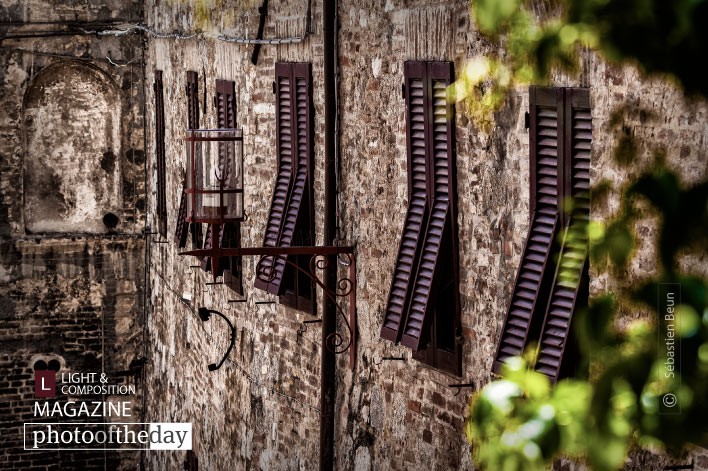
Sébastien Beun
Born in 1981, Belgian photographer Sébastien Beun began his creative journey at the age of twelve after discovering his father’s vintage darkroom equipment. His early fascination with developing black and white negatives eventually evolved into a dedicated practice in digital photography. Based in Thuin, Beun approaches his craft with a deep appreciation for the history of the medium, often documenting the subjects and environments that resonate with his personal experiences while maintaining a profound respect for traditional photographic techniques.
Resonance Score Breakdown
Transparency Note: The resonance score (12.4/20) is calculated based on social engagement metrics collected before the award announcement.
Expert Photography Reviews · 8
The Architecture of Secrets
We build walls to keep the world at bay, yet we leave gaps for the light to find us. There is a quiet, stubborn dignity in a closed shutter—a boundary drawn between the public sun and the private pulse of a room.
Read the reflection →The Quiet Between Walls
There is a particular kind of wisdom in the things we choose to close. We often think of openness as the only way to be, yet there is a sacredness in the threshold, in the gentle barrier that guards the inner life from the glare of the world.
Read the reflection →Reviews & Comments
Share your thoughts about this award-winning photograph. Your reviews contribute to the community engagement score.
Sunlight in San Gimignano isn’t a gift; it’s a violent interrogation of stone. Beun’s shutters don’t merely block the heat; they carve deep, jagged voids into the facade, forcing the architecture to confront its own silence. I’ve spent hours staring at these slats, and it’s unsettling how they refuse to yield their interior secrets. It’s a cold, calculated refusal. When I look at these shadows, I don’t see Tuscany. I see the heavy, impenetrable weight of history.
Sun-drenched afternoons in Tuscany are a dime a dozen, and frankly, they’re usually a tourist’s excuse for a lazy shutter finger. One wonders if Beun merely stumbled upon these shutters while hunting for gelato. The texture of the stone is decent, but it lacks the grit of a long, cold vigil. I’ve spent weeks waiting for light to truly bite into masonry. This feels like a pleasant walk, not a hard-won prize. It’s pretty, but it’s cheap.
In San Gimignano, we don’t just see stone and wood; we see the quiet guardians of a thousand secrets. These shutters are closed, yet they’re listening. They’ve held back the Tuscan heat and the weight of centuries. I find myself leaning in, wondering who stood behind them, watching the world pass by. It’s a portrait of a home that prefers to keep its own counsel. I love how it feels like a hushed, private conversation.
The light hits those shutters and the frame snaps into focus. It’s a tight, rhythmic sequence of wood against stone. I love how the shadows bleed into the medieval texture; it feels like a long, silent take in a period drama. The cut would’ve been a mistake here. Beun understands that the tension isn’t in the wall, but in what’s hidden behind those slats. It’s a perfect, held breath of Tuscan heat. I’m hooked.
The sun here doesn’t just illuminate; it presses against the stone, heavy and ancient. He stood in that Tuscan heat, waiting for the shadows to carve depth into the wood. It’s a quiet intimacy, isn’t it? I find myself wanting to reach out and touch the grain, to feel the cool dark behind those shutters. He didn’t rush the light. He let the wall breathe, capturing a silence that only exists when the world stops moving.
At f/9, the 130mm focal length renders the wood grain with startling micro-contrast. The diffraction limit hasn’t yet softened the edges, allowing the lens to resolve the weathered timber’s cellular structure against the stone. It’s a clinical dissection of Tuscan light. I’m genuinely moved by how the chromatic aberration remains absent at the high-contrast junctions. It’s rare to see a sensor capture such tactile history without losing the nuance of the shadow’s depth. It’s simply exquisite.
Before the eye identifies the shutters, a sudden stillness settles in the chest. It’s the weight of that Tuscan stone, pressing against the lungs. I’ve spent years returning to this frame, and it still triggers a phantom heat on my skin. The way the light catches those wooden slats—it’s a barrier I want to push open. It doesn’t just document architecture; it demands a privacy I’m not sure I’m ready to share.
You’ve captured the weight of those stone walls, but it’s the shutters that caught me. I’ve spent enough time in Italy to know that silence behind a closed window. You waited for the light to hit that wood just right, and it feels like a secret kept for centuries. It’s not just architecture; it’s the feeling of a midday nap in a cool, dark room. You felt the stillness, and you let the camera hold it.
Very nice