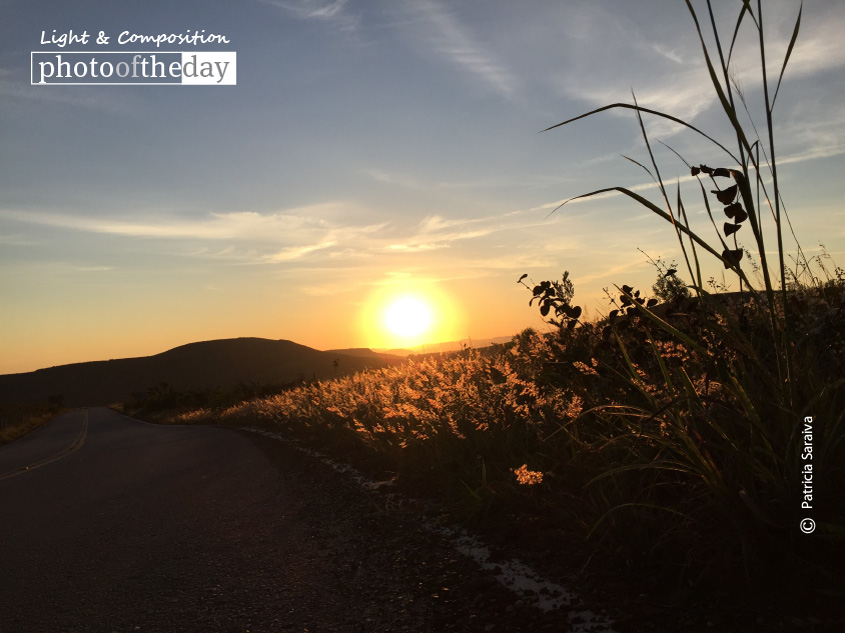
Plantation of Gold by Patricia Saraiva
The photographer ascended the mountain under the cover of darkness, waiting patiently for the first light of dawn to break over the horizon. As the sun began to rise, it cast a brilliant, ethereal glow across the landscape, transforming the terrain into a shimmering plantation of gold. This fleeting moment of natural enchantment was captured with precision, highlighting the dramatic interplay between shadow and light. The image is award-worthy for its evocative atmosphere and the photographer's ability to translate a quiet, early-morning observation into a radiant, timeless visual narrative.
Patricia Saraiva
Born in Apucarana, Brazil, in 1969, Patricia Saraiva is a dedicated plastic surgeon who discovered her profound passion for photography while documenting the milestones of her two children. Her artistic journey evolved from personal family records to professional recognition, including her celebrated exhibition 'Barcelona Balconies' and contributions to the catalog of Baroque master Aleijadinho. Based in Belo Horizonte, she remains a committed visual storyteller, constantly refining her craft and sharing her unique perspective on the world through her evocative, borderless digital imagery.
Resonance Score Breakdown
Transparency Note: The resonance score (12.4/20) is calculated based on social engagement metrics collected before the award announcement.
Expert Photography Reviews · 8
The First Breath of Day
I remember sitting on a stone wall in a village outside of Lucca, waiting for the sun to clear the ridge. An old man named Giuseppe walked past, his boots crunching on the gravel.
Read the reflection →The Alchemy of Morning
There is a quiet, almost religious discipline in the act of waiting for the sun.
Read the reflection →Reviews & Comments
Share your thoughts about this award-winning photograph. Your reviews contribute to the community engagement score.

The horizon holds its breath. Light spills across the Serra do Rola Moca, turning the earth to metal. It’s quiet here. I’ve stood in this exact stillness before, waiting for the sun to define the edges of the world. Nothing here is accidental. The empty corner is not empty. It’s a pause. A deliberate withdrawal of detail that lets the gold breathe. I find myself leaning in, wanting to disappear into that shadow.
The ochre light here doesn’t merely touch the Serra do Rola Moca; it saturates the earth like a Turner sky caught in the brushwork of a Morandi still life. It’s a chromatic fever, that specific, bruised gold of a dying ember, and I’ve found myself breathless, almost weeping at the way the shadows cling to the ridges like velvet. It’s not just a sunrise, but a visceral, golden ache that lingers long after one looks away.
You climbed that mountain in the dark, and I can feel the cold air hitting your face as you waited. It’s a quiet, lonely kind of patience. Most people would’ve slept in, but you caught that first light turning the grass into something precious. It’s honest. I’ve stood on ridges like that, shivering and waiting for the world to wake up, and you’ve captured that exact feeling of being small before something vast. You were there.
At f/2.2, the iPhone 6 sensor struggles with the diffraction limit, yet here, the light’s interaction with the Serra do Rola Moca grasses is sublime. The focal plane renders the foreground with a crispness that defies the tiny 4.2mm lens’s inherent limitations. I’m genuinely moved by how the sensor handles that golden spectral spill; it’s a rare, luminous clarity. It doesn’t just capture a sunrise; it resolves the very physics of dawn’s first, fleeting, radiant touch.
The light hits the Serra do Rola Moca and the frame catches fire. It’s a wide shot that demands silence. I’ve spent hours in edit suites waiting for a transition this perfect, but here, the cut would’ve been a mistake. The iPhone sensor caught the gold bleeding into the shadows, a fleeting sequence frozen in time. It’s breathless. I feel the chill of that mountain air just looking at it. That’s the frame the editor keeps.
Gold shouldn’t be this heavy. In the Serra do Rola Moca, Saraiva captures a light that doesn’t invite, but demands. It’s a violent gilding of the earth. I’ve spent hours staring into these deep, encroaching hollows, and I’m unsettled by how the darkness refuses to retreat. It’s not just a sunrise; it’s a confrontation. When the shadows hold their ground against such radiance, they prove that the mountain isn’t merely seen, but felt as a burden.
1/2326sec at f/2.2, ISO 32, 4.2mm. A smartphone sensor pushed to its limit. The aperture is fixed, forcing a reliance on digital processing that I usually despise. Yet, the exposure is dead-on. It’s sharp where it matters. I’ve spent years hating phone optics, but the dynamic range here actually holds up. It’s a clean capture of a fleeting light condition. The technical choices were limited, but she didn’t waste the hardware. It’s surprisingly competent work.
Most sunrise shots are forgettable clichés, but this iPhone capture hits differently. It’s the raw, jagged texture of the Serra do Rola Moça that saves it; the light doesn’t just hit the hills, it bruises them into gold. I’ve seen thousands of landscapes, yet this one makes me ache for that specific, freezing Brazilian dawn. It’s not perfect, but it’s honest. In thirty years, we’ll still recognize this quiet, golden desperation for what it is.