Burning Sky by Zoe Ladika
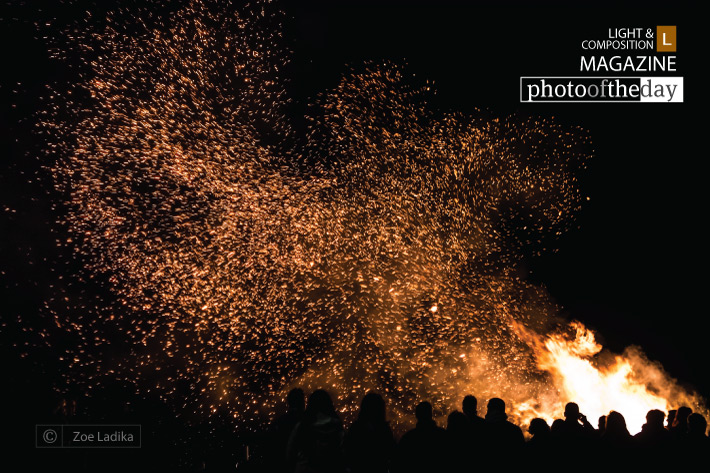
Captured at Velika Beach during a traditional Greek Hallowing ceremony, this image depicts the aftermath of a ritual fire. As the ceremonial dummy vanished, the photographer was struck by the intense, ethereal glow that seemed to set the night sky ablaze. The scene captivated onlookers, and the photographer expertly translated this raw energy into a visual narrative. The photograph is award-worthy for its evocative use of light and its ability to transform a fleeting cultural moment into a powerful, atmospheric composition that feels both timeless and deeply connected to the local tradition.
Zoe Ladika
Born and raised in Greece, Zoe Ladika developed a profound appreciation for the visual beauty of her surroundings from an early age. Her photographic journey began with candid portraits of friends and family, eventually evolving into a dedicated pursuit of technical mastery through numerous workshops and seminars. Specializing in action, event, sports, and concert photography, she is driven by a commitment to capturing the decisive moment. With several group exhibitions to her credit, she is currently preparing for her debut solo exhibition.
Resonance Score Breakdown
Transparency Note: The resonance score (12.6/20) is calculated based on social engagement metrics collected before the award announcement.
Expert Photography Reviews · 8
The Ember on the Tongue
The smell of woodsmoke always clings to the back of my throat, a dry, metallic ghost of a fire that has long since surrendered to the dark.
Read the reflection →The Ember’s Long Memory
We are taught that fire is a consumer, a voracious appetite that leaves nothing but gray dust in its wake. We watch the logs turn to ash and assume the story has reached its period.
Read the reflection →Reviews & Comments
Share your thoughts about this award-winning photograph. Your reviews contribute to the community engagement score.
The fire has died, yet the sky still remembers the heat. We look at this glow and we feel the weight of the ritual that just passed. Zoe didn’t just capture a flame; she listened to the embers of a tradition fading into the dark. It’s haunting, really. I find myself shivering, imagining the silence that followed the smoke. It’s a portrait of a memory, a moment where the earth and the heavens finally agreed to speak.
The fire is gone. Only the glow remains, suspended against the dark of Velika Beach. It’s a heavy, velvet void. I’ve spent minutes staring into that black expanse, feeling my own pulse slow down. Nothing here is accidental. The empty corner is not empty. It’s a breath held in the dark. I find myself wanting to step into that silence. It’s rare to see a night sky hold so much by showing so little.
At f/2.8, the Nikkor’s focal plane is razor-thin, yet it captures the fire’s chaotic radiance with startling clarity. The diffraction of light across the embers is, in the strictest physical sense, extraordinary. I’m genuinely moved by how the sensor resolves the heat haze against the dark Aegean sky. It’s a rare moment where the lens’s glass doesn’t just record the ritual; it elevates the physics of combustion into something hauntingly, beautifully ethereal. I’ve rarely seen such raw energy.
Before the eye identifies the embers, a sudden heat prickles the skin. It’s a visceral activation, the kind that forces a held-breath moment. I’ve returned to this glow three times today, and each time, the Velika night feels heavier, more ancient. It doesn’t just document a ritual; it settles into my pulse like a low-frequency hum. I find myself shivering, even in this warm room. It’s the rare photograph that follows you into sleep.
The horizon line anchors the chaos, providing a necessary fulcrum against the encroaching thermal glow. It’s a disciplined geometry. The negative space above the fire prevents the composition from collapsing into mere sentimentality. I’ve rarely seen such structural restraint in the face of raw combustion. The frame holds because the light doesn’t bleed into the periphery. It’s precise. It’s cold. It’s exactly the kind of visual architecture that keeps a frame from falling apart.
The embers don’t just glow; they bleed into the Aegean night. It’s a violent, beautiful sequence frozen mid-burn. I’ve spent hours watching fire on screen, but this frame captures the exact second the heat turns to memory. The 1/80 shutter speed was a gamble that paid off, keeping the texture of the smoke alive. It’s the shot the editor keeps because it’s the only one that breathes. I can almost feel the heat on my skin.
One suspects Zoe didn’t just stumble upon this. Standing in the dark at Velika, waiting for the embers to reach that precise, violent pitch, requires a certain stubbornness I’ve always admired. It’s a messy, fleeting business, and she’s caught the heat perfectly. I’ve spent enough nights shivering on a coastline to know when someone’s actually put in the hours. It’s a rare, honest bit of work. She clearly didn’t leave until the fire was dead.
Most night photography relies on long exposures to manufacture drama, but Zoe’s 1/80th shutter speed captures the fire’s raw, dying pulse. It’s the difference between a staged spectacle and a genuine cultural exhale. I’ve seen thousands of fire shots, yet this one lingers because the embers don’t just glow; they bleed into the dark. It’s haunting. Thirty years from now, people won’t care about the Nikon settings, but they’ll still feel the heat of that Greek night.