Hong Kong from behind the Lines by Ryszard Wierzbicki
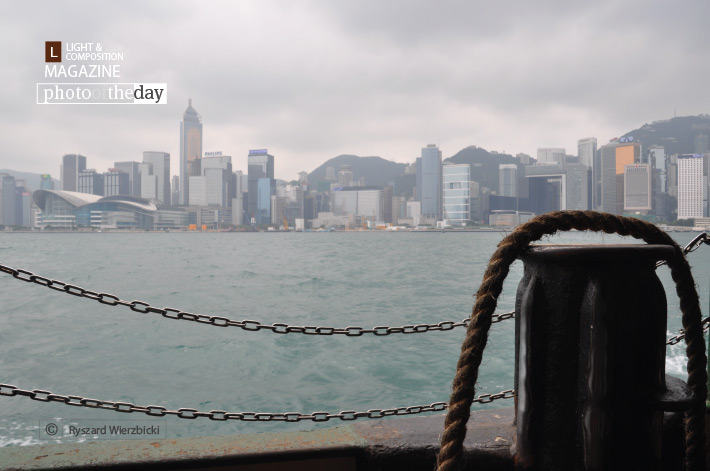
Captured during a ferry crossing of Hong Kong Bay in July 2014, this image offers a unique perspective of the city's iconic skyline. By positioning the camera behind the ferry’s barrier lines, the photographer created a compelling frame that juxtaposes the industrial texture of the ship against the sprawling urban landscape beyond. This deliberate choice of framing transforms a standard travel view into a layered narrative, highlighting the contrast between the traveler's immediate environment and the distant, shimmering metropolis. The composition’s depth and the precise balance of light and shadow make it a standout example of evocative travel photography.
Ryszard Wierzbicki
Born in 1963 and a graduate of the University of Gdańsk, Ryszard Wierzbicki transitioned from a diverse career in education and marketing to become a dedicated traveler and photographer after relocating to the United Kingdom in 2006. His work is deeply influenced by his extensive travels across South-East Asia and his commitment to humanitarian efforts, including volunteering with orphanages in Thailand and Burma. As the founder of the Instant Travelling and World Around forums, Wierzbicki actively fosters a community for explorers, blending his professional expertise in marketing with a profound passion for documenting the world through his lens.
Resonance Score Breakdown
Transparency Note: The resonance score (14.0/20) is calculated based on social engagement metrics collected before the award announcement.
Expert Photography Reviews · 8
The View Through the Gate
I remember sitting on a rusted bench in Marseille, watching a group of teenagers play cards near the docks. Between us and the open sea stood a heavy, chain-link fence, its metal worn smooth by decades of salt air.
Read the reflection →Watching Through the Bars
I spent this morning sitting on my porch, watching the neighborhood wake up through the iron slats of the railing. It is strange how much more you notice when your view is partially blocked.
Read the reflection →Reviews & Comments
Share your thoughts about this award-winning photograph. Your reviews contribute to the community engagement score.
The ferry’s rusted iron, a bruised ochre reminiscent of Morandi’s dustier palettes, creates a jarring, tactile friction against the distant skyline’s cool, synthetic cyan. It’s a chromatic dissonance that aches; I’m truly unsettled by how the humidity turns the air into a thick, opalescent veil, muting the city’s neon pulse into a ghostly, Turner-esque haze. One feels the salt air clinging to the lens, a beautiful, suffocating weight that makes the urban sprawl feel like a fever dream.
The ferry’s rusted railing isn’t just a frame; it’s a cage. By forcing the skyline through these jagged, dark apertures, Wierzbicki denies us the city’s easy shimmer. He makes us watch Hong Kong through the grit of our own confinement. It’s claustrophobic, and frankly, it makes my chest tighten. We aren’t tourists here; we’re prisoners of the view. Light doesn’t reveal the city; it only highlights the bars that keep us from ever truly touching it.
Most travel shots of Hong Kong are postcards I’ve seen a thousand times. What separates this from the pack is the grit of those rusted ferry railings. By forcing the skyline through that industrial cage, Wierzbicki makes the city feel like a prize you’re barely allowed to touch. It’s claustrophobic and brilliant. I felt a genuine shiver of nostalgia looking at it; it’s exactly how the city felt to me a decade ago. That’s why it endures.
1/160sec at f/13, ISO 200, 18mm. Stopping down to f/13 was the right call. It forces the industrial barrier into sharp, unforgiving focus, anchoring the frame against the distant skyline. I’ve seen a thousand Hong Kong shots, but this one doesn’t drift into soft sentimentality. The diffraction at f/13 is negligible here. It’s a cold, calculated trade-off that actually works. I find myself respecting the sheer rigidity of the choice. It’s technically sound.
Before the eye identifies the skyline, a sudden constriction hits the chest. The rusted ferry railing acts as a physical barrier, forcing me to view the city through a cage of industrial decay. It’s a claustrophobic ache, a reminder that we’re always separated from the shimmering promise of the horizon. I’ve returned to this frame for years, and that cold, metallic grit still makes me hold my breath, waiting for a release that never comes.
At f/13, the diffraction limit begins to soften the micro-contrast, yet the Nikon’s sensor captures the ferry’s wire mesh with startling clinical precision. It’s a fascinating optical paradox; the focal plane renders the foreground lines with such tactile grit that the distant skyline feels almost ethereal. I’m genuinely moved by how the lens resolves those metallic textures against the atmospheric haze. It’s a rare moment where the physics of the glass perfectly frames the city’s complex, shimmering geometry.
The ferry’s railing slices the frame, a hard, industrial cut that forces the eye to fight for the skyline. It’s a brilliant edit. Wierzbicki doesn’t just show us Hong Kong; he traps us behind the steel, making the city feel like a distant, unreachable dream. I love the grit of those lines against the soft, shimmering light. It’s the shot the editor keeps because it’s the only one that tells the truth about the journey.
The ferry’s rusted barrier cuts through the frame, a cold, industrial silence against the city’s hum. I’ve spent enough hours on the water to know the humidity Wierzbicki felt that July day. He didn’t just capture a skyline; he waited for the light to soften the steel. It’s a quiet, lonely perspective. Looking at those blurred lines, I feel a sudden, sharp ache for the stillness he found amidst the chaos of the bay.