First World Problems by Jessica Gershen
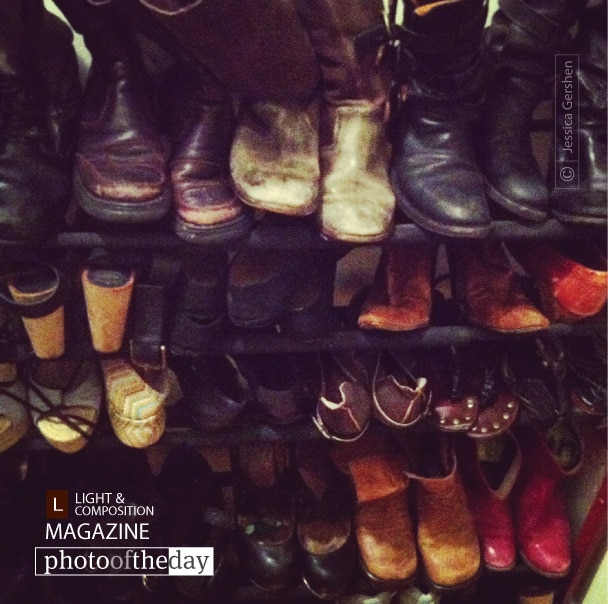
In 'First World Problems,' Jessica Gershen captures a poignant still life that serves as a visual archive of a decade. By documenting a collection of well-worn shoes, the photographer explores the stark contrast between past luxury and present struggle. The composition is intimate and tactile, using the worn textures of the footwear to represent the passage of time and the shedding of a former life. This image is award-worthy for its raw emotional honesty, transforming mundane personal objects into a powerful narrative about identity, memory, and the complex reality of living between two worlds.
Jessica Gershen
Based in New York City, Jessica Gershen has cultivated a photographic practice rooted in the observation of human behavior and urban life. After exploring formal fine arts education at the Rochester Institute of Technology, she chose to pursue photography as a dedicated personal passion to preserve her creative spontaneity. Influenced by the work of Diane Arbus and the vibrant energy of her surroundings, Gershen captures evocative, narrative-driven imagery that reflects her unique perspective on the complexities of modern existence.
Resonance Score Breakdown
Transparency Note: The resonance score (13.3/20) is calculated based on social engagement metrics collected before the award announcement.
Expert Photography Reviews · 5
The Weight of Old Soles
I spent an hour this morning clearing out the back of my closet. I found a pair of boots I haven’t worn in years.
Read the reflection →The Weight of the Path
We leave pieces of ourselves behind in the things we no longer use. A coat that no longer fits the shape of our shoulders. A pair of boots that have walked too many miles on hard, unforgiving ground.
Read the reflection →Reviews & Comments
Share your thoughts about this award-winning photograph. Your reviews contribute to the community engagement score.
The palette here evokes a Morandi-esque melancholy, where the dusty ochre of worn leather meets the bruised, slate-grey shadows of a Kensington floor, creating a chromatic tension that’s almost unbearable. It’s a quiet, tactile ache; I’ve found myself mesmerized by how the light clings to those scuffed heels like fading memories. One doesn’t merely see these objects; one feels the heavy, muted resonance of a life discarded, rendered in tones of profound, lingering regret.
A collection of discarded footwear shot on an iPhone 4. It’s a curious choice of tool for a narrative about shedding one’s past. One wonders if the photographer lingered long enough to let the dust settle, or if it was a fleeting impulse. I’ve spent days waiting for light to hit a single stone, so I find this lack of technical rigor frustrating. Still, the worn leather does ache with a quiet, genuine exhaustion.
These discarded shoes aren’t merely leather and tread; they’re the husks of a discarded self. Gershen forces us to confront the void where a foot once resided. It’s haunting. I’ve spent hours staring at the way the light dies against the scuffed heels, refusing to illuminate the interior darkness. It’s a brutal, honest geometry. When I look at these shadows, I don’t see luxury lost. I see the heavy, suffocating weight of a life finally standing still.
Before the eye identifies the scuffed leather, something in the chest tightens. It’s the weight of a life discarded in a Kensington hallway. I feel a sudden, sharp ache for the person who once stepped into these heels, now just hollow shells of ambition. When I return to this a year later, the silence feels heavier. It’s not just shoes; it’s the physical residue of who we were before the world demanded we change.
Leather heels. Scuffed toes. They’ve been discarded against the floorboards. I feel a sudden, sharp ache in my chest looking at them. It’s the weight of the floor. The dust. The light doesn’t reach the corners, and that’s where the truth hides. Nothing here is accidental. The empty space isn’t empty. It’s a quiet room holding a life that’s already left. It’s enough. The silence is heavy. It’s perfect.