Girls are the Best by Ryszard Wierzbicki
Captured in the remote Muang Noi region of Laos, this candid portrait highlights a moment of profound dignity. While visiting a village accessible only by boat to distribute school supplies, the photographer encountered a young girl whose pride and independence left a lasting impression. By choosing to decline gifts, she became the embodiment of resilience and self-sufficiency. The image is award-worthy for its raw, authentic connection between the subject and the lens, capturing a fleeting, poignant interaction that transcends cultural barriers and celebrates the spirit of childhood in the most isolated corners of the world.
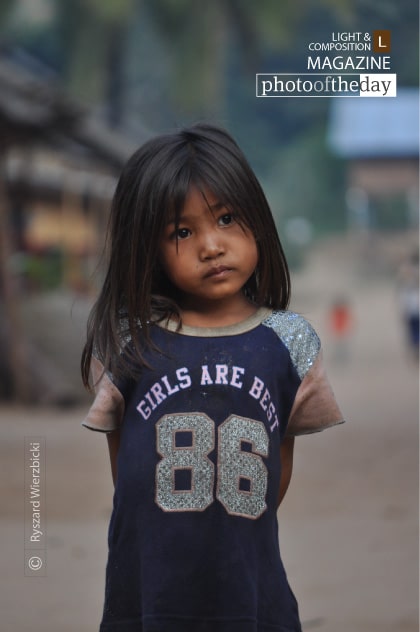
Exposure 1/250sec @ f/5.6 | ISO 500 | Focal Length 300mm
Ryszard Wierzbicki
Born in 1963, Ryszard Wierzbicki is a Polish-born photographer and educator currently based in Swindon, United Kingdom. With a background in social sciences and child care, he transitioned from a corporate career to pursue a life defined by travel, scuba diving, and photography. His work is deeply influenced by his exploration of South-East Asia and his commitment to volunteering with orphanages. Through his platforms, Instant Travelling and World Around, he shares his passion for documenting the human experience and the diverse cultures he encounters across the globe.
Resonance Score Breakdown
Transparency Note: The resonance score (13.8/20) is calculated based on social engagement metrics collected before the award announcement.
Expert Photography Reviews · 5
The Quiet Strength of Roots
There is a particular kind of grace found in those who stand firmly on their own ground, even when the world expects them to lean. We often mistake softness for a need to be filled, assuming that every hand held out is a request for something we possess.
Read the reflection →The Weight of Enough
I was at the grocery store this morning, watching a little girl insist on carrying her own basket. It was far too heavy for her, and she kept stumbling, but every time her mother reached out to help, she pulled away with a fierce, stubborn shake of her head.
Read the reflection →Reviews & Comments
Share your thoughts about this award-winning photograph. Your reviews contribute to the community engagement score.
The ochre dust of Muang Noi clings to the girl’s skin like a memory of sun-drenched earth, harmonizing with the muted, earthy umbers that Morandi would have adored. It’s a palette of quiet resilience, where the light doesn’t merely illuminate but breathes, casting a soft, atmospheric haze that makes my heart ache with its fragile, unadorned truth. One finds here a chromatic dignity that transcends the mere capture of a face, revealing a soul painted in shadow.
The light here isn’t forced; it’s the soft, diffused glow of a humid Laotian afternoon, wrapping around her face like a quiet secret. Ryszard didn’t rush this. He waited in the stillness of Muang Noi until she was ready to be seen. Looking at her steady, unyielding gaze, I’m struck by a sudden, sharp ache of humility. It’s a rare thing to find a soul so complete, standing entirely on its own, needing nothing from us.
At 300mm, the focal plane is razor-thin, isolating her gaze from the chaotic bokeh of the Laotian foliage. The Nikon’s sensor resolves the fine texture of her skin against the diffraction limit of an f/5.6 aperture. It’s a delicate optical balance. I’m genuinely moved by how the lens captures the precise micro-contrast in her eyes; it’s a clarity that feels almost intrusive, yet it’s the only way to truly honor such fierce, quiet independence.
1/250sec at f/5.6, 300mm equivalent. ISO 500. It’s a shaky reach for a D5000. The compression at 300mm flattens the background, isolating the subject effectively. I’ve seen enough soft telephoto shots to know the struggle, but Wierzbicki hit the focus. It’s sharp where it counts. I’m actually impressed he didn’t lose the eyes to motion blur. The technical execution is sound. It’s a precise capture of a fleeting, difficult moment. The numbers hold up.
The subject’s placement within the frame creates a precarious spatial tension. It’s a rigid geometry that forces the eye toward the periphery, where the negative space doesn’t quite resolve. The vertical alignment is sharp, yet the background clutter threatens the structural integrity of the portrait. I’m frustrated by the lack of tonal separation here. It’s technically sound, but the composition lacks the necessary fulcrum to anchor the subject’s gaze. It’s nearly a perfect frame, but it’s missing discipline.