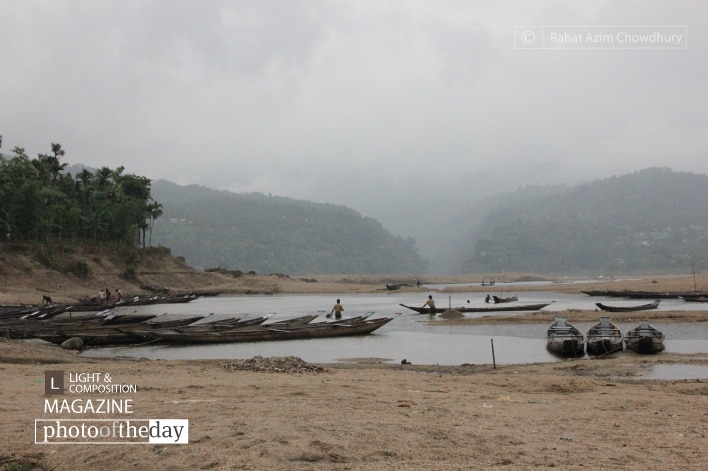
Dauki River Boats by Rahat Azim Chowdhury
Captured in November 2012, this evocative landscape depicts the Dauki River in Jaflong, a region renowned for its bustling stone-collecting industry and proximity to the Meghalaya hills of India. The photographer braved three days of continuous rainfall to document the scene, embracing the challenging weather to capture the raw, atmospheric essence of the riverboats against the misty backdrop. This image is award-worthy for its successful translation of a difficult, rain-soaked environment into a serene and textured composition, highlighting the photographer's commitment to capturing the authentic spirit of nature despite adverse conditions.
Rahat Azim Chowdhury
Born in 1984 in Dhaka, Bangladesh, Rahat Azim Chowdhury is a computer engineer who transitioned into photography as a dedicated creative pursuit. Influenced by his peers and a rigorous program of self-study, he has developed a keen eye for nature, street, and lifestyle photography. He is committed to establishing a unique artistic signature, focusing his lens on the architectural and social patterns of diverse cultures. Driven by a desire to document the human experience rather than commercial gain, he continues to refine his craft through professional training and global exploration.
Resonance Score Breakdown
Transparency Note: The resonance score (12.9/20) is calculated based on social engagement metrics collected before the award announcement.
Expert Photography Reviews · 7
The River’s Quiet Breath
There is a particular kind of grace found in the rain. It does not ask for our attention; it simply falls, washing the world into a softer, more muted palette.
Read the reflection →The Weight of the Current
We often mistake stillness for an absence of movement, forgetting that the deepest waters are those that carry the most history.
Read the reflection →Reviews & Comments
Share your thoughts about this award-winning photograph. Your reviews contribute to the community engagement score.
Rain doesn’t just fall here; it erases the boundary between the river and the sky. Chowdhury’s boats are ghosts, tethered to a world that’s dissolving into gray. I’ve spent hours staring at these hulls, and it’s the encroaching gloom that haunts me—a silence so heavy it feels like a physical weight. He hasn’t just captured a landscape; he’s surrendered to the void. It’s a rare, cold honesty that refuses to offer us any comfort at all.
The horizon line bisects the frame with clinical indifference. It’s a rigid anchor against the atmospheric bleed of the mist. The boats occupy the lower quadrant, their dark hulls providing the necessary compositional weight to ground the vaporous sky. I’ve grown weary of such romanticized weather, yet the spatial tension here holds. The geometry doesn’t collapse under the weight of the rain. It’s a disciplined arrangement of mass that finally earns its place within the frame.
Rain blurs the boundary between water and sky. The boats sit low, anchored in the gray. I’ve spent minutes watching the mist swallow the hills. It’s quiet here. The stillness isn’t just weather; it’s a deliberate choice. Chowdhury lets the river breathe. Nothing here is accidental. The empty corner is not empty. It holds the weight of the rain. I feel a sudden, sharp ache for that silence. It’s a rare, cold peace.
Three days of rain, and finally, the river exhaled. Rahat stood in that damp, grey silence, waiting for the mist to soften the jagged stone-collecting scars. It’s a quiet ache, seeing those boats tethered in the flat, directionless light. I’ve felt that same chill in my bones, the dampness seeping into the camera bag. He didn’t force the scene; he let the river’s exhaustion become the composition. It’s a humble, honest surrender to the weather.
Before the eye identifies the boats, a damp chill settles in the chest. It’s the weight of that gray, rain-heavy sky pressing against the lungs. I feel my own breath hitch, mirroring the stillness of the Dauki. When I return to this a year later, the mist hasn’t lifted; it’s settled into my memory like a persistent fog. It’s a quiet, aching isolation that makes me want to pull my coat tighter against the cold.
Most travel photography is just visual noise, but here, the rain isn’t a nuisance; it’s the subject. By shooting at f/11, Chowdhury forced the mist to hold its shape, turning the riverboats into ghosts against the grey. I’ve seen thousands of river shots, but the way the water bleeds into the sky here makes me want to shiver. It’s a quiet, cold endurance that will still feel honest in thirty years. That’s why it won.
The palette here doesn’t merely describe the Dauki; it breathes, exhaling the bruised, slate-grey melancholy of a Turner seascape. It’s the silver-blue of rain-slicked stone meeting the muted, mossy ochre of the riverbanks, a harmony so fragile I’ve found myself holding my breath. One feels the damp chill in those charcoal shadows, a tonal depth that Morandi would have cherished, where the mist isn’t just weather, but a veil of soft, melancholic light. It’s truly haunting.