Michinoku by Jose Renteria
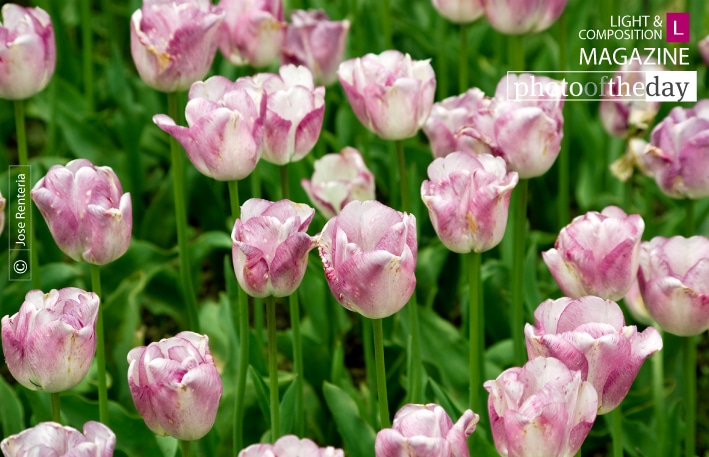
Captured in the vibrant Tohoku region of Japan, this photograph showcases the breathtaking beauty of Michinoku’s natural park during the peak of spring. The photographer focused on a delicate arrangement of tulips, representing only a fraction of the hundreds of thousands of flowers that blanket the landscape. By isolating these blossoms, the image highlights the serene, colorful essence of the season. This piece is award-worthy for its masterful use of natural light and composition, which transforms a vast floral display into an intimate, tranquil portrait of Japan’s seasonal splendor.
Jose Renteria
Born in Veracruz, Mexico, in 1973 and raised in Guadalajara, Jose Manuel Renteria Cobos is a professional airline pilot currently based in Osaka, Japan. Balancing his aviation career with a deep passion for photography, he specializes in aviation, street, and landscape imagery. A dedicated Pentax user since the early 2000s, he views photography as a creative escape and a way to explore the interplay of time and space, constantly seeking to refine his technical skills through his travels across Japan.
Resonance Score Breakdown
Transparency Note: The resonance score (13.3/20) is calculated based on social engagement metrics collected before the award announcement.
Expert Photography Reviews · 6
The Weight of Petals
Spring is a violent arrival. After the long, grey stillness, the earth does not wake gently; it erupts. We are taught to look for the grand scale, the mountain, the forest, the horizon.
Read the reflection →The Velvet Pulse of Spring
The smell of damp earth after a long, brittle winter is a heavy, sweet perfume that clings to the back of the throat. It is the scent of waking up.
Read the reflection →Reviews & Comments
Share your thoughts about this award-winning photograph. Your reviews contribute to the community engagement score.
The frame doesn’t collapse under the weight of the tulips. It’s a disciplined isolation. The 100mm focal length compresses the depth, forcing the blossoms into a rigid, planar arrangement. Negative space is absent, yet the spatial tension remains taut. I’m actually relieved by the lack of horizon line here. It’s a clinical dissection of color. The composition holds because it refuses the chaos of the wider landscape. It’s a precise, architectural success.
The light here isn’t forced; it’s a soft, diffused glow that breathes life into these petals. I’ve spent enough mornings waiting for such clarity to know Jose stood there in the quiet, letting the Tohoku air settle before he dared to release the shutter. It’s an intimate conversation with the earth. Looking at these tulips, I feel a sudden, sharp ache for the stillness of that spring. He didn’t just photograph flowers; he listened to them.
Tulips in Tohoku shouldn’t feel this heavy. Renteria isolates these petals, yet he’s neglected the void beneath them. It’s a bright, spring-time postcard that refuses to acknowledge the silence of the earth. I’ve stared at these blossoms, waiting for a flicker of darkness to ground them, but they’re floating in a vacuum. It’s pretty, sure, but it’s afraid of its own depth. Without shadow, the beauty doesn’t resist; it just evaporates into the light.
The tulips pulse with a saturated, bruised magenta that recalls the velvet shadows in a Morandi still life, bleeding into the pale, ethereal green of stems that feel like they’ve been dipped in the cool, diffused light of a Vermeer interior. It’s a chromatic ache, really; I’ve found myself breathless before these petals, their delicate, waxy luminosity vibrating against the soft, blurred Tohoku air until the entire frame dissolves into a singular, shivering, floral respiration.
Most floral photography is just wallpaper, but this works because Renteria resists the urge to capture the entire field. By isolating these specific tulips against the soft, out-of-focus greens, he forces us to confront their fragility. I’ve seen thousands of spring shots, yet this one makes me feel a genuine, quiet ache for the season’s brevity. It’s the restraint that ensures this will still matter in thirty years. It doesn’t just show flowers; it defines them.
It’s easy to snap a field of tulips; it’s quite another to find the stillness within the chaos. Renteria has resisted the urge to capture the entire meadow, choosing instead to isolate a quiet, deliberate arrangement. One wonders how many hours he spent kneeling in the damp Tohoku soil to catch that precise, soft light. I’ve spent enough mornings shivering in similar fields to appreciate the discipline here. He didn’t just find this; he earned it.