Asilah by Keith Goldstein
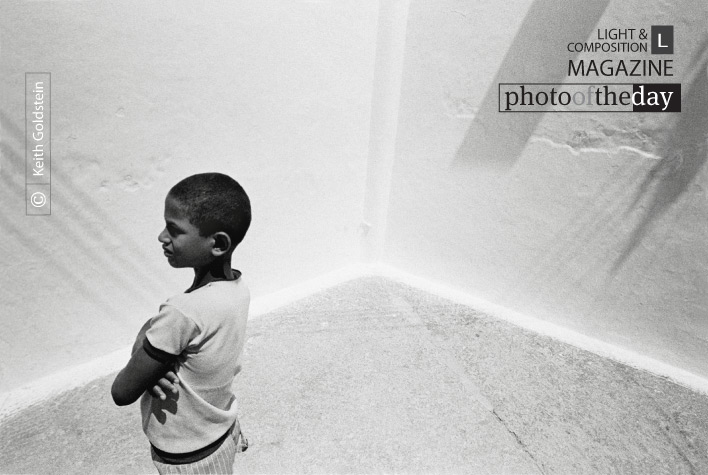
Captured in the historic, fortified town of Asilah, this candid portrait of a young Moroccan boy serves as a poignant window into life along the Atlantic coast. The photographer utilized the classic Leica M4 and Ilford HP5 film to document the quiet intensity of the subject against the backdrop of ancient, medieval ramparts. By choosing a monochromatic medium, the image emphasizes texture and raw human emotion over color, resulting in a timeless aesthetic. This photograph is award-worthy for its masterful composition and the photographer's ability to forge an intimate, authentic connection with the subject in a fleeting, unposed moment.
Keith Goldstein
Born in Brooklyn in 1957, Keith Goldstein is a seasoned fine art and editorial photographer based in Hamilton Heights, New York City. After earning his BFA from the School of Visual Arts and his MFA from the Cranbrook Academy of Art, he developed a deeply emotive, unencumbered approach to the medium. With a career spanning over four decades, his work has been featured in numerous international publications and exhibitions, reflecting his lifelong commitment to exploring the world through a minimalist, documentary lens.
Resonance Score Breakdown
Transparency Note: The resonance score (12.2/20) is calculated based on social engagement metrics collected before the award announcement.
Expert Photography Reviews · 4
The Architecture of Silence
In the ancient cities of the Mediterranean, the walls are not merely boundaries; they are archives. If you press your palm against the stone of a rampart that has stood for centuries, you feel the vibration of a thousand lives that have passed through the same narrow arteries.
Read the reflection →The Architecture of Silence
We are often told that history is written in ink or carved into stone, but I suspect it lives more vividly in the soft, unformed gaze of the young.
Read the reflection →Reviews & Comments
Share your thoughts about this award-winning photograph. Your reviews contribute to the community engagement score.
Before the eye identifies the boy, a sudden stillness settles in the chest. The grain of the film feels like grit against the skin, grounding the Atlantic wind. I’ve returned to this print a dozen times, and each time, his gaze pulls me into that ancient, fortified shadow. It’s the weight of his quiet intensity that lingers; it follows me home, settling into my own memory like a secret I wasn’t meant to keep.
28mm at f/2.8 on film. It’s a tightrope walk. Goldstein’s choice of the Elmarit creates a sharp transition from the boy’s eyes to the crumbling ramparts. The depth of field is unforgiving, yet the focus holds. I’ve spent years staring at these mechanical traces, and honestly, the precision here actually makes me stop and breathe. It’s a rare instance where the gear doesn’t get in the way of the intent. The exposure is dead on.
Shadows here don’t merely frame the boy; they consume the ramparts, forcing us to confront the void behind his gaze. It’s a heavy, suffocating silence. When I look at those deep, ink-stained corners, I feel a sudden, sharp ache for the things he hasn’t yet lost. Goldstein doesn’t just capture a moment; he traps time in the grain. It’s a brutal, honest refusal to let the light offer any easy comfort. I find it haunting.
The 28mm Elmarit’s rendering of the Asilah ramparts is a masterclass in edge-to-edge micro-contrast. At f/8, the focal plane is razor-thin, yet it resolves the boy’s skin texture against the stone’s coarse grain with startling clarity. I’m genuinely moved by how the silver halides in the HP5 capture the diffraction of light across those ancient surfaces. It’s not just a portrait; it’s a precise optical intersection where the lens’s glass finally meets the soul of the subject.