The Geometry of Waiting
In the middle of the nineteenth century, the philosopher Henry David Thoreau suggested that we are often in such a hurry to construct our magnetic telegraphs from Maine to Texas that we might find, upon completion, that Maine and Texas have nothing important to say to each other. We build the conduits, the roads, and the iron rails, obsessed with the velocity of connection, yet we rarely pause to consider the space between the points. There is a peculiar, quiet dignity in being stalled. When the momentum of a day is forcibly interrupted—when the engine cuts out and the world stops moving at our command—we are suddenly forced to inhabit the geography we usually only traverse. We become observers of the architecture of our own delay. We notice the way the lines of the pavement converge toward a horizon we never intended to reach. If we stop long enough, the chaos of the thoroughfare begins to reveal a hidden, rhythmic order. Is it possible that we only truly see the world when we are prevented from rushing through it?
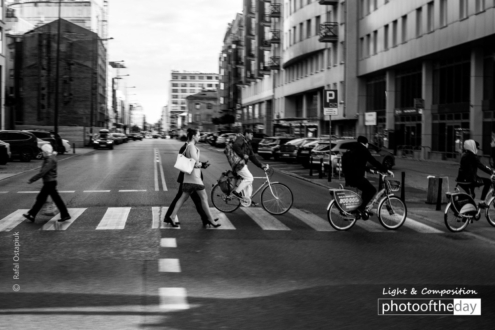
Rafal Ostapiuk has captured this stillness in his work titled Road. He reminds us that even in the heart of a city’s frantic pulse, there is a grace to be found in simply standing still. Does the road lead us somewhere, or does it merely exist to be seen?