The Geometry of Motion
Seneca once remarked that life is like a play; it matters not how long it lasts, but how well it is performed. We spend so much of our existence concerned with the destination, the final outcome of our labors, that we often neglect the grace found in the act itself. There is a profound, quiet dignity in a task performed for its own sake, without the burden of ambition or the anxiety of the future. When we engage in the simple mechanics of play, we are not merely passing time; we are participating in a rhythm that has existed since the first human hands shaped wood and stone. To be fully absorbed in the spinning of a top, or the flight of a kite, is to briefly escape the tyranny of the clock. It is a reminder that we are at our most human when we are not trying to be anything other than what we are in this singular, fleeting heartbeat. What remains when the motion finally ceases?
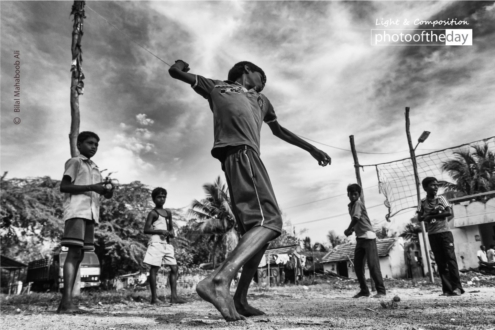
Bilal Mahaboob Ali has captured this essence in his work titled Bambaram. It serves as a gentle reminder that the most enduring joys are often found in the simplest of movements. Does this image stir a memory of a time when you, too, were lost in the rhythm of play?