Thresholds of the Sacred City
We often speak of the city as a machine of commerce or a grid of transit, but the true urban fabric is woven from the quiet, persistent rituals of its inhabitants. In the dense, vertical sprawl of a metropolis, sacred spaces act as vital pressure valves. They are the few places where the relentless pace of the street is suspended, allowing for a different kind of human geography to emerge. Here, the social hierarchies that define our daily commutes—who has the right of way, who occupies the center, who is relegated to the periphery—are momentarily softened. Yet, even in these sanctuaries, one must wonder about the invisible lines of access. Who is permitted to find stillness, and whose labor is required to maintain the silence for others? We are all searching for a place to anchor ourselves amidst the noise, but the city rarely offers such refuge without a price. What happens to the spirit when the walls of the temple are the only thing standing between an individual and the crushing weight of the urban machine?
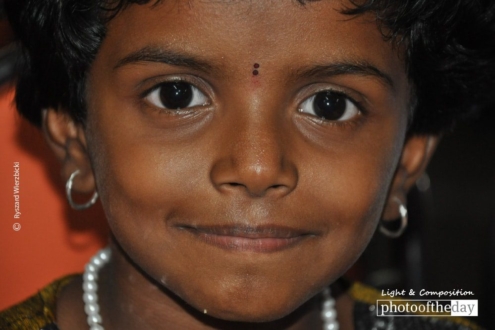
Ryszard Wierzbicki has taken this beautiful image titled An Indian Girl in Temple. It captures a moment of quiet reflection that feels both deeply personal and inextricably linked to the surrounding city. Does this space offer her a sense of belonging, or is it merely a temporary escape from the streets outside?