King’s Flight by Tamal Debnath
During a Sunday excursion with his mentor, Nirupam Roy, the photographer captured the Common Kingfisher in a moment of striking agility. Drawn to the bird since childhood, the photographer seized the opportunity when the creature descended from its perch to hunt, resulting in a dynamic mid-flight image. The photograph is award-worthy for its precise timing and the clarity with which it freezes the kingfisher’s movement, showcasing the beauty of wildlife in its natural habitat through a disciplined and observant lens.
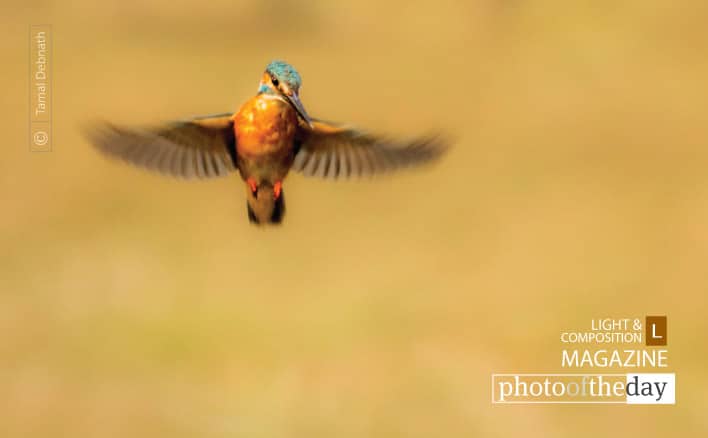
Exposure 1/400sec @ f/6.3 | ISO 400 | Focal Length 300mm
Tamal Debnath
Based in Cooch Behar, West Bengal, Tamal Debnath is an English language school teacher and dedicated amateur photographer. Since beginning his photographic journey in 2008, he has cultivated a deep passion for the craft, constantly refining his skills by observing the work of others. He views his camera as a lifelong companion and a source of daily inspiration, using it to document the natural world with patience and curiosity.
Resonance Score Breakdown
Transparency Note: The resonance score (13.1/20) is calculated based on social engagement metrics collected before the award announcement.
Expert Photography Reviews · 8
The Architecture of Air
We spend our lives tethered to the gravity of the ground, measuring our days in footsteps and the slow, steady accumulation of dust. We forget that the air is not merely an empty space to be filled, but a structure waiting to be inhabited.
Read the reflection →The Architecture of a Second
In the study of physics, there is a concept known as the infinitesimal—a slice of time so thin it defies the human capacity for measurement.
Read the reflection →Reviews & Comments
Share your thoughts about this award-winning photograph. Your reviews contribute to the community engagement score.
The bird cuts through the air. It’s a sharp blue line against the muted grey of the marsh. I’ve spent minutes watching the stillness surrounding the wings. It’s not just a hunt. It’s a breath held in the reeds. The empty space isn’t empty; it’s the weight of the flight itself. I feel a sudden, quiet ache in my chest. Nothing here is accidental. The silence is loud. It’s perfect.
At 300mm, the Nikon’s glass struggles against the diffraction limit, yet it’s captured the kingfisher’s iridescent plumage with surprising fidelity. The focal plane is razor-thin, barely containing the bird’s rapid trajectory. I’m genuinely moved by how the shutter speed has arrested that frantic wing-beat, revealing structural details our eyes usually blur into motion. It’s a rare moment where the physics of the lens finally catches up to the sheer velocity of life. It’s quite beautiful.
The frame’s geometry hinges on the kingfisher’s trajectory. It’s a calculated diagonal, slicing the negative space with clinical precision. The bird’s wingspan provides the necessary fulcrum, anchoring the composition against the blurred backdrop. It doesn’t rely on sentiment; it relies on the sheer weight of the avian form. I’ve rarely seen such structural economy in wildlife work. The tension holds because the subject refuses to drift. It’s a rare, disciplined alignment of motion and mass.
A kingfisher in flight is a frantic, blue blur, yet here it’s held perfectly still. One suspects Debnath didn’t just stumble upon this; he likely spent hours in the humid Tufanganj heat, muscles cramping, waiting for the bird to commit. It’s a rare, disciplined bit of work. I’ve spent enough mornings shivering in a blind to know the sheer stubbornness required to nail that focus. He earned this frame. It’s a fine, honest piece of patience.
Most wildlife shots are just technical exercises in freezing motion, but this one hits differently. I’ve seen thousands of kingfishers, yet the way the wings blur against the sharp, focused eye makes me hold my breath. It’s the tension between that frantic energy and the stillness of the background that earns its place here. It’s not just a bird in flight; it’s a captured heartbeat. In thirty years, we’ll still be watching this hunt.
There’s a stillness in the air at Tufanganj that only the patient truly know. Tamal didn’t just chase a bird; he waited for the light to align with the kingfisher’s intent. Watching that flash of blue suspend itself against the soft, muted backdrop, I feel a sudden, sharp ache for the quiet of the riverbank. It’s an act of pure listening. He stood there, breathless, until the land finally granted him this fleeting, perfect grace.
The electric cerulean of the kingfisher’s plumage vibrates against the muted, muddy ochres of the West Bengal wetlands, a chromatic dissonance that’s almost violent in its intensity. It’s a Morandi-esque stillness shattered by a sudden, brilliant streak of sapphire light. I’ve found myself breathless, truly, watching how that sharp, metallic turquoise cuts through the humid, stagnant air; it’s a visceral, painterly collision of pigment that makes one’s pulse quicken with the sheer, unadulterated joy of colour.
The kingfisher’s flight isn’t merely a hunt; it’s a violent rupture in the stillness of the Bengal marsh. Debnath captures the bird, yet I’m haunted by the murky, unlit void behind those wings. It’s a cold, indifferent abyss that swallows the creature’s frantic energy. When I look at that dark, suffocating background, I feel a sudden, sharp loneliness. It’s not a celebration of nature, but a reminder that light is just a brief, desperate defiance of the dark.