A Home Made Strawberry Tartlet by Rasha Rashad
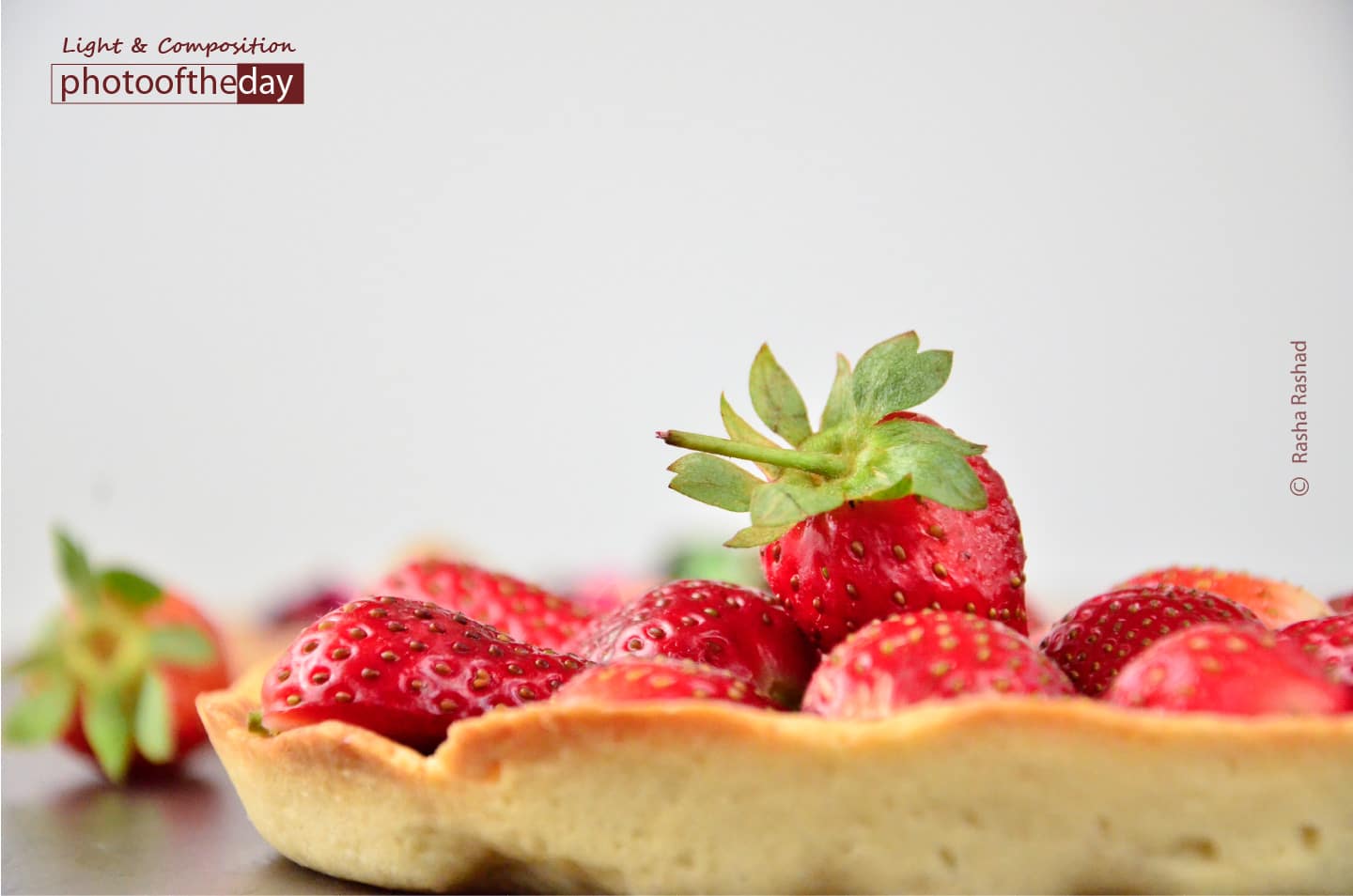
Captured for an eye-level food photography assignment, this image showcases a meticulously prepared strawberry tartlet set against a clean, white background. To achieve a sense of vibrant freshness, the photographer applied water to the fruit and utilized careful refrigeration. The composition is elevated by the deliberate scattering of strawberries and dried flowers, which add texture and color to the frame. This photograph is award-worthy for its masterful use of natural styling and lighting, which transforms a simple homemade dessert into a sophisticated, visually appealing subject that highlights the beauty of culinary detail.
Rasha Rashad
Hailing from Alexandria, Egypt, Rasha Rashad is a dedicated explorer and photographer who transitioned from a corporate career to pursue her creative passions full-time. Her work is deeply influenced by her love for literature, cinema, and the diverse cultures she encounters during her travels. Specializing in both street and food photography, Rashad brings a keen eye for detail and a narrative-driven approach to her imagery, consistently capturing the essence of her subjects with artistic precision.
Resonance Score Breakdown
Transparency Note: The resonance score (12.5/20) is calculated based on social engagement metrics collected before the award announcement.
Expert Photography Reviews · 8
The Architecture of Sweetness
When a strawberry begins to ripen, it draws sugars from the plant’s vascular system, concentrating the sun’s energy into a fragile, crimson vessel designed specifically to be consumed.
Read the reflection →The Sweetness of Patience
There is a quiet grace in the act of preparing something with one’s own hands. It is a slow conversation between the maker and the ingredients, a way of honoring the earth that provided the fruit and the time that allowed it to ripen.
Read the reflection →Reviews & Comments
Share your thoughts about this award-winning photograph. Your reviews contribute to the community engagement score.
The crimson of these strawberries, glistening like wet rubies against the clinical, sterile white, evokes a tension reminiscent of a Morandi still life, yet it’s far more visceral. One feels a sudden, sharp hunger for that glossy, jammy red. It’s a chromatic collision; the dried petals offer a muted, dusty rose counterpoint that softens the tartlet’s aggressive freshness. I’m utterly captivated by how the light catches the moisture, turning simple fruit into pure, edible light.
There’s a quiet stillness here that reminds me of dawn in the desert. Rasha didn’t just photograph a tartlet; she waited for the light to settle on those droplets until they held the room’s entire soul. I find myself wanting to reach out, not to eat, but to touch the cool, damp surface of the fruit. It’s rare to find such reverence for the ephemeral. She listened to the light, and it answered back.
Technically, it’s flawless. The water droplets on those strawberries? They’re crisp. But where’s the pulse? I’m looking for the chaos of Cairo, the grit of the street, not a sterile studio setup. Cartier-Bresson would’ve waited for a stray crumb or a hand reaching in. It’s too controlled, too safe. I’m craving the mess of life, not a perfect tartlet. It’s pretty, sure, but it doesn’t breathe. It’s just a photograph, not a moment.
Most food photography is disposable, destined for a quick scroll and immediate forgetting. Rasha’s tartlet avoids this fate because of the deliberate, messy scattering of dried flowers against the sterile white. It’s a tension between domestic chaos and clinical precision that I find genuinely refreshing. Of the thousands of culinary shots I’ve reviewed, this one lingers. It isn’t just a dessert; it’s a quiet, tactile memory of a kitchen that I’d actually want to visit.
The tartlet sits at the intersection of a perfect golden spiral, anchoring the frame’s negative space. Rashad’s distribution of strawberries creates a rhythmic sequence of red vectors, pulling the eye across the white plane in a calculated arc. It’s a precise spatial equation. I’m genuinely charmed by how the scattered petals break the rigid geometry, adding a chaotic variable to the equation. It’s a rare, balanced solution where every crumb serves a clear, structural purpose.
The clinical, high-key isolation here evokes the sterile precision of early commercial studio work, yet the scattered petals disrupt that rigid order. It’s a delicate tension, reminiscent of Penn’s minimalist still lifes, though far more domestic. I’m genuinely charmed by how the water droplets catch the light; they add a tactile, fleeting vitality that elevates the tartlet beyond mere catalog fodder. It’s a refreshing, modern dialogue with the tradition of the Dutch masters’ vanitas, minus the decay.
White space breathes. It’s a relief. The tartlet sits, anchored by the weight of its own stillness. I’ve spent minutes watching the water droplets cling to the fruit. They don’t demand attention. They simply exist. The scattered petals aren’t clutter. They’re a rhythm. I feel a sudden, quiet hunger—not for the sugar, but for the calm. Nothing here is accidental. The empty corner is not empty. It’s the pause that holds the entire frame together.
The focal plane here is razor-thin, isolating the strawberry’s cellular structure with clinical precision. I’m genuinely moved by how the lens resolves those tiny water droplets; the refraction within each sphere creates a miniature, inverted world. By pushing the aperture to its limit, the bokeh softens the background into a creamy, neutral field that doesn’t distract. It’s a rare moment where the physics of light perfectly captures the ephemeral, glistening texture of fresh fruit. It’s simply exquisite.