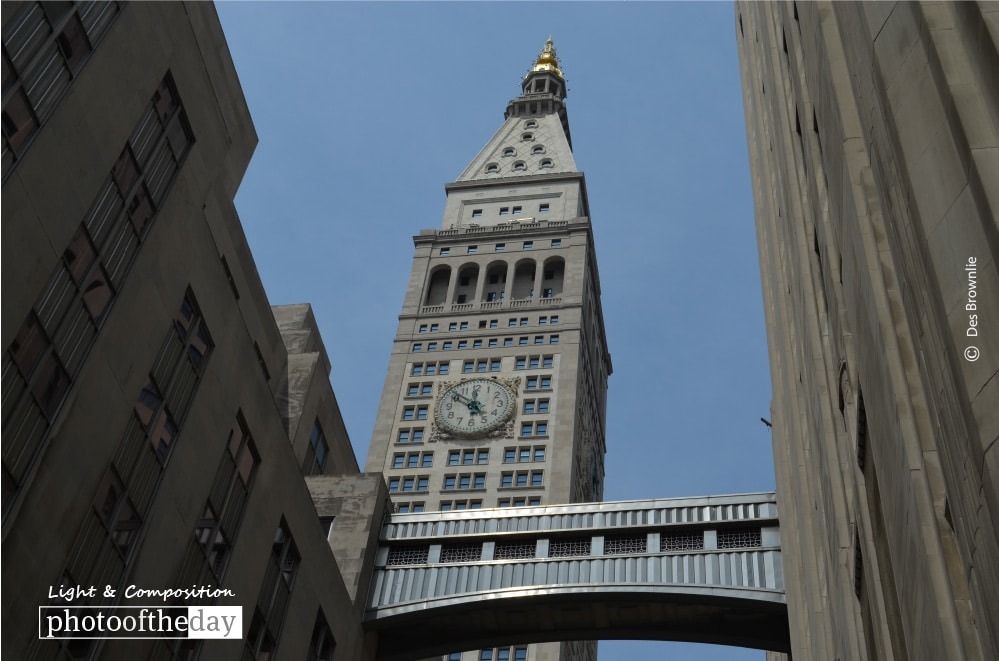
MET Life Tower and Bridge by Des Brownlie
Captured in the heart of the Flat Iron district, this image highlights the historic Met Life Clock Tower, a 1911 architectural marvel that once dominated the Manhattan skyline. The photographer was drawn to the intricate details and unique character of these early 20th-century structures, which stand in stark contrast to the modern skyscrapers that now surround them. By pausing during a walk through Madison Square Park, the photographer successfully framed this piece of urban history against the evolving cityscape. The photograph is award-worthy for its ability to isolate the timeless elegance of the clock tower, offering a poignant reminder of New York’s rich architectural heritage amidst the city's relentless growth.
Des Brownlie
Originally hailing from Glasgow, Scotland, Des Brownlie relocated to New York City eighteen years ago and has since become a dedicated observer of the urban landscape. Based in Manhattan, he specializes in documenting the diverse tapestry of city life, finding beauty in both the ordinary and the extraordinary. His photographic practice is defined by a constant readiness to capture the vibrant color and variety of his surroundings, viewing every daily walk as an opportunity to discover and preserve the unique spirit of New York through his lens.
Resonance Score Breakdown
Transparency Note: The resonance score (12.0/20) is calculated based on social engagement metrics collected before the award announcement.
Expert Photography Reviews · 7
The Architecture of Memory
Time is not a straight line, but a layering of stone and breath. We walk through cities built upon the ghosts of older intentions, where the sharp edges of the new press against the weathered skin of the past.
Read the reflection →The Weight of Stilled Seconds
Why do we build monuments to time, as if we could ever truly capture it? We stack stone and steel into the sky, carving faces into clocks that watch the world hurry by, yet the hands only ever point to a present that has already slipped away.
Read the reflection →Reviews & Comments
Share your thoughts about this award-winning photograph. Your reviews contribute to the community engagement score.
It’s a shame we’re so obsessed with the Met Life Tower’s crisp edges. Why resolve every brick when the city itself is a blur of motion? I’d have loved to see Brownlie surrender that Nikon’s sharpness for a long-exposure smear, echoing Sugimoto’s ghostly theatres. Instead, it’s a standard postcard. I’m genuinely bored by this technical safety. Why choose to resolve the tower so perfectly when the real story is the chaos surrounding it?
Before the eye identifies the clock tower, a sudden stillness settles in the chest. It’s the weight of time pressing against the glass. I feel a strange, hollow ache looking at those rigid, historic lines hemmed in by the city’s frantic pace. When I return to this, I don’t see architecture; I see the persistence of memory. It’s a quiet, lonely pulse that follows me home, reminding me how quickly we’re being outgrown.
The Nikon D5100’s sensor struggles against the diffraction limit here, yet the Met Life Tower’s masonry retains a crisp, geometric integrity. I’m genuinely moved by how the focal plane isolates those 1911 limestone textures from the encroaching modern glass. It’s a delicate optical balancing act. While the chromatic aberration along the tower’s edges betrays the lens’s limitations, the sheer clarity of that clock face against the shifting Manhattan skyline is, quite frankly, a beautiful technical triumph.
We look at the Met Life Tower and we don’t just see stone; we see an elder standing tall amidst a crowd of hurried, glass-faced youth. It’s a portrait of a city’s memory. I feel a quiet ache looking at how the clock face watches over the park, patient and still. Des Brownlie didn’t just frame a building; he listened to the history etched into its skin. It’s a photograph that asks to be returned to.
The Met Life Tower’s verticality is a sharp datum against the sky, yet the frame’s tight crop ignores the park’s threshold. It’s a clean composition, but it flattens the tower’s mass, turning a tactile 1911 marvel into a mere silhouette. I’ve walked this park a thousand times; I miss the way the light hits those ornate cornices. It’s a pretty view, sure, but it doesn’t capture the weight of history pressing against the modern glass.
The clock tower rises. It doesn’t fight the sky. It breathes. I’ve spent minutes watching how the stone meets the void. It’s quiet here. The bridge cuts through, yet the stillness remains. Nothing here is accidental. The empty corner is not empty. It’s a pause in a city that’s forgotten how to stop. I feel a sudden, sharp ache for this silence. It’s rare. It’s enough.
The Met Life Tower functions as a dominant vertical axis, bisecting the frame into a precise 1:2 ratio of negative space. The bridge’s sweeping curve creates a necessary counter-vector, anchoring the tower’s rigid geometry against the park’s organic chaos. It’s a beautifully solved spatial equation. I’m genuinely struck by how the clock face acts as the absolute center of visual gravity. It doesn’t just occupy space; it dictates the entire mathematical equilibrium of the Manhattan skyline.