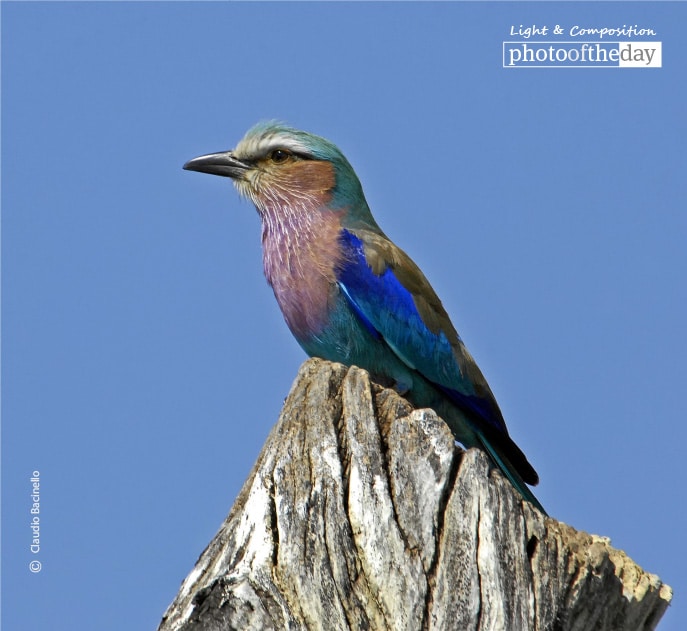
Lilac Breasted Roller by Claudio Bacinello
Captured during a safari along the Chobe River in Botswana, this image documents a dramatic moment in the life of a Lilac-Breasted Roller. After successfully defending its nest from a larger eagle, the bird paused to rest, allowing the photographer to secure this striking portrait. The composition highlights the bird's vibrant plumage against the natural backdrop, showcasing the intense, fleeting beauty of wildlife in its habitat. This photograph is award-worthy for its ability to transform a tense, high-stakes avian encounter into a serene, masterfully framed study of color and resilience.
Claudio Bacinello
Born in Italy, Claudio Bacinello is a Thornhill, Canada-based photographer with a distinguished career spanning three decades. His diverse portfolio encompasses weddings, portraits, and corporate work, though his current focus centers on travel, wildlife, and nature photography. Driven by a passion for exploration, he frequently travels to Africa and South America to document compelling stories. His work has achieved global recognition and is widely sought after for both private and corporate fine art collections.
Resonance Score Breakdown
Transparency Note: The resonance score (12.1/20) is calculated based on social engagement metrics collected before the award announcement.
Expert Photography Reviews · 7
The Quiet After the Storm
I spent this morning trying to fix a leaky faucet in the kitchen. It was one of those small, nagging tasks that I had been putting off for weeks, and I was convinced it would take me all of ten minutes.
Read the reflection →The Architecture of Resilience
We often mistake stillness for an absence of history, forgetting that every quiet moment is merely the sediment of a storm that has already passed. To stand firm after the wind has torn at your branches is not a lack of movement, but a deliberate choice to hold your ground.
Read the reflection →Reviews & Comments
Share your thoughts about this award-winning photograph. Your reviews contribute to the community engagement score.
The lilac-breasted roller’s plumage erupts in a violent, electric turquoise that reminds one of Turner’s most fevered Venetian skies, yet it’s the soft, bruised violet of the throat that truly catches my breath. It’s a chromatic collision, a Morandi-esque stillness set against the arid, ochre heat of the Chobe. I’m utterly undone by how the bird’s chest holds that delicate, dusty lavender, grounding the frantic brilliance of its wings in such quiet, aching grace.
The Lilac-Breasted Roller’s plumage is a violent riot of color, yet it’s the encroaching gloom behind the bird that haunts me. Bacinello hasn’t just captured a creature; he’s trapped a silence. I’ve stared at those dark, blurred reeds until my eyes ached, feeling the weight of the predator it just survived. It’s a cold, existential stillness. When the light hits that breast, it doesn’t invite us in—it demands we acknowledge the darkness that remains.
It’s technically crisp, but I’m left craving a bit of chaos. Bacinello’s Roller is sharp enough to count every feather, yet that’s exactly why it feels static. Why resolve every detail when the bird’s life is defined by the blur of flight? I’d have preferred a shutter drag to capture the kinetic energy of that territorial defense. It’s a pretty portrait, sure, but it lacks the visceral, experimental tension I’m always hunting for.
You waited for the adrenaline to fade, didn’t you? Most people would have fired away during the fight, but you caught the quiet aftermath. I’ve spent enough time in the field to know that stillness is harder to capture than action. Looking at those feathers, I feel the weight of that bird’s exhaustion. It’s a small, fragile victory. You didn’t just document a bird; you captured the relief of survival. That’s honest work.
Before the eye identifies the bird, a sudden stillness anchors the chest. It’s the color—that impossible, electric lilac—that triggers a sharp, involuntary intake of breath. I’ve returned to this frame three times today, and each time, the tension of the Chobe riverbank dissolves into a quiet, pulsing resilience. It doesn’t just document a survivor; it forces my own pulse to slow. I find myself wanting to touch those feathers, just to feel the heat.
Of the thousands of wildlife portraits I’ve reviewed, most are just sharp feathers on a branch. What separates this from the pack is the bird’s posture; it’s not merely perched, it’s recovering. That subtle tension in the wings tells me the story of the fight before the shutter clicked. I’ll admit, the sheer saturation of those blues makes me catch my breath. It’s a rare, enduring record of survival that’ll still matter in thirty years.
The bird sits. A pause after the struggle. The background isn’t just blur; it’s a soft, muted void that lets the lilac feathers breathe. I’ve spent minutes staring at the negative space behind the wing. It’s heavy. It’s quiet. Nothing here is accidental. The empty corner is not empty. It’s where the tension goes to rest. I feel a strange, sudden calm looking at it. It’s enough. It’s perfect.