Vanity Table by Barry Cawston
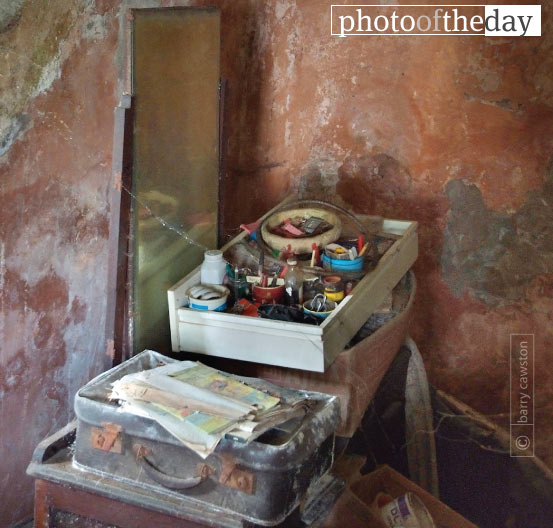
Captured within the quiet, undisturbed rooms of a family home, this photograph documents a space left untouched for over two decades. The photographer focused on the interplay of peeling wallpaper, delicate cobwebs, and scattered personal artifacts to reveal the eccentric Victorian character of the domestic environment. By framing these remnants of daily life, the image serves as a poignant time capsule. Its award-worthy quality lies in the evocative storytelling and the ability to transform a mundane, decaying interior into a compelling still life that invites the viewer to contemplate the passage of time and the history embedded in personal spaces.
Barry Cawston
Based in Axbridge, Somerset, Barry Cawston is a distinguished freelance photographer whose work has been featured by prominent institutions such as English Heritage, The Guardian, and The Sunday Telegraph. Known for his technical mastery, he frequently utilizes a large-format field camera and traditional darkroom printing techniques to imbue his images with profound emotional resonance. His acclaimed career includes winning the South West Art Award and the Nikon Endframe Award, alongside numerous solo exhibitions in London’s prestigious art galleries. Cawston continues to push the boundaries of his craft through ambitious international projects and large-scale photographic installations.
Resonance Score Breakdown
Transparency Note: The resonance score (13.3/20) is calculated based on social engagement metrics collected before the award announcement.
Expert Photography Reviews · 6
The Weight of Dust
We leave things behind. Not because we want to, but because the rhythm of living eventually slows. A house is a shell, and inside, the air grows heavy with the things we no longer touch.
Read the reflection →The Weight of Stilled Air
We often speak of time as a river, something that pulls us forward, relentless and fluid. But there is another way to experience it: as a sediment.
Read the reflection →Reviews & Comments
Share your thoughts about this award-winning photograph. Your reviews contribute to the community engagement score.
Decay isn’t a tragedy; it’s a slow, deliberate surrender to the dark. Here, the peeling wallpaper doesn’t just flake—it exhales. I’ve stared at these cobwebs until my eyes ached, feeling the heavy, suffocating silence of a room that refuses to be forgotten. It’s haunting how the shadows swallow the vanity’s edges, turning personal artifacts into relics of a ghost. It doesn’t invite us in; it forces us to confront the inevitable rot of our own existence.
The dust motes dancing in that thin, filtered light feel like ghosts of a life once lived. I’ve spent hours in rooms just like this, waiting for the silence to settle. Cawston didn’t rush; he listened to the decay. It’s haunting how the peeling wallpaper holds the weight of twenty years. Looking at those delicate cobwebs, I feel a sudden, sharp ache for the people who once sat here, brushing their hair in the quiet.
The composition demands a rigorous reading of the vanity’s central axis. The peeling wallpaper creates a chaotic texture, yet the mirror’s frame anchors the visual weight. It’s a precarious balance. The negative space around the scattered artifacts doesn’t quite hold the eye, causing the frame to leak focus. I’ve grown weary of such domestic decay, but the structural tension here is undeniable. It’s a disciplined study that barely survives its own clutter.
Dust doesn’t settle like that in an afternoon. One suspects Cawston spent a fair few hours breathing in the damp rot of that Birmingham house before the light hit the vanity just so. It’s a quiet, claustrophobic sort of patience I’ve grown to respect. I find myself shivering slightly looking at those cobwebs; it’s a cold, lonely kind of commitment. He didn’t just find this room, he earned the silence within it.
The peeling wallpaper’s sickly, bruised ochre bleeds into the dust-choked air, echoing the muted, melancholic stillness of a Morandi canvas. It’s a haunting, sepia-toned decay that makes my heart ache for the ghosts of Birmingham. One finds the light here doesn’t illuminate so much as it mourns, casting a pallor of exhausted cream across these forgotten trinkets, where the colour of stagnant time settles like silt upon the vanity’s fragile, splintering wooden bones.
Most still lifes of decay feel staged, but this one breathes. I’ve sat through thousands of submissions, and what separates this from the usual dusty-room trope is the deliberate tension between the peeling wallpaper and the vanity’s fragile geometry. It’s haunting. I actually felt a chill looking at those cobwebs; they aren’t just debris, they’re anchors for a ghost. In thirty years, this won’t just be a photo—it’ll be the only evidence that this life mattered.