The Weight of Memory
There is a peculiar gravity to stone that has outlived the hands that placed it. We often think of history as a series of dates or a sequence of battles, but it is more accurately a slow, silent accumulation of weight. Consider the basalt, cooled from the earth’s own molten heart, now standing as a barrier against the passage of time. It does not speak, yet it holds the imprint of every shadow that has ever crossed its surface. We walk past these remnants of human ambition, rarely stopping to consider that the wall is not merely a structure, but a witness. It has seen the transition from day to night, from one century to the next, absorbing the cooling air as if it were a long, exhaled breath. We are so fleeting in our movements, so quick to rush toward the next horizon, while the stone simply waits, anchored in its own permanence. If the walls could remember the warmth of the sun they held all day, would they feel the coming night as a relief or a burden?
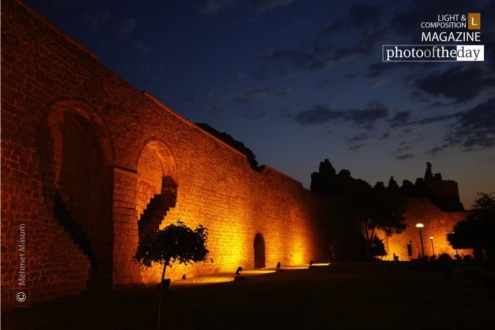
Mehmet Masum has captured this quiet endurance in his work titled After Sunset Castle of Diyarbakir. It is a meditation on how history settles into the dark, and I wonder, what do you hear when you stand before a silence that has lasted for thousands of years?