The River of Many
In the study of fluid dynamics, there is a concept known as laminar flow, where particles move in parallel layers, never crossing paths. It is a tidy, predictable way to understand water. But human history rarely behaves with such mathematical grace. We are more like a turbulent current, swirling and colliding, driven by forces we can feel but cannot always name. We gather in places where the earth feels thin, where the boundary between the mundane and the infinite seems to fray. We do this not because we are seeking order, but because we are seeking the comfort of being a single drop in a vast, moving body. There is a strange, quiet power in losing one’s own edges to the collective. We stand in the mud, we look toward the horizon, and we wait for the water to wash away the singular weight of our own names. If we are all moving in the same direction, does it matter if we know where the current ends?
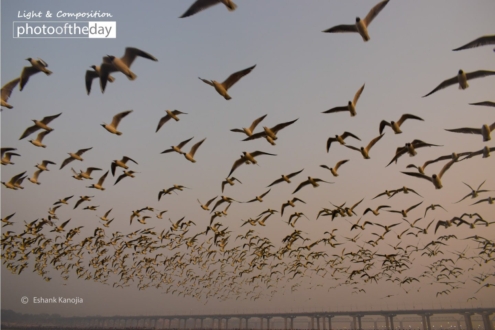
Eshank Kanojia has captured this profound sense of scale in the image titled Kumbh Mela. It is a reminder of how small we are, and yet, how much space we can fill when we move together. Does the river change the people, or do the people change the river?