
The Mirror of What Remains
I remember sitting in a waiting room in Leeds, watching a man trace the pattern of the linoleum floor with his shoe. He wasn’t looking at the magazines or the clock on the wall; he was staring at the way the fluorescent light pooled in a puddle of spilled coffee near his feet. It was a perfect, inverted image of the ceiling, distorted and dark. We spend so much of our lives trying to keep our heads above the surface, terrified of what happens when the world turns upside down. But sometimes, the only way to see the truth of a thing is to look at its shadow, or its reflection in a broken pool. We fear the distortion, yet it is often in the reversal that we finally recognize the shape of our own grief. It is a quiet, heavy kind of clarity—the realization that even when the world breaks, it still holds the light. How do you find your footing when the ground beneath you starts to mirror your own uncertainty?
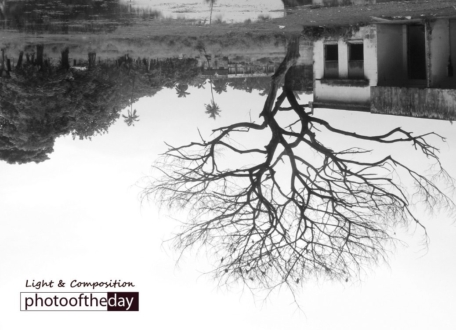
Liton Chowdhury has captured this fragile duality in his work titled A Dead Reflection. It is a haunting reminder that even in our darkest moments, we are still looking for a way to make sense of the world. Does this image feel like a mirror to you, or a window?