
The Geometry of Waiting
In the nineteenth century, the clock tower became the heartbeat of the city, a mechanical pulse that forced the fluid nature of human time into rigid, predictable segments. We are taught to measure our lives in these segments, to believe that a minute is a container that must be filled with productivity. Yet, there is a quiet rebellion in the act of lingering. When we stop to watch a wheel turn—or a star move, or the tide pull away from the shore—we step outside the clock’s jurisdiction. We begin to see that time is not a line, but a circle, a slow rotation that carries us through darkness and back toward the light. It is a strange comfort, realizing that we are all suspended in this same slow orbit, waiting for the next turn of the wheel to reveal what we could not see in the shadows. If the world stopped spinning for a moment, would we finally recognize the shape of our own patience?
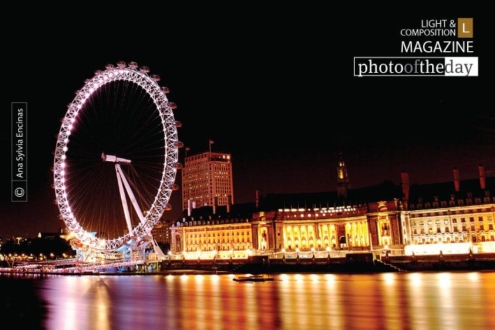
Ana Sylvia Encinas has captured this stillness in her work titled London Eye at Night. She invites us to stand on the riverbank and watch the world rotate in a golden, glowing loop. Does the city look different to you when you stop counting the minutes?