
The Geometry of Silence
In the quiet hours of the morning, before the city fully wakes, there is a particular kind of order that reveals itself. It is not the order of people or movement, but the order of things left behind—the chimneys, the vents, the flat planes of tar and gravel that stretch out like a map of human necessity. We often think of the city as a chaotic tangle, a place where voices overlap and paths collide. Yet, if you climb high enough, the noise begins to thin. You find that the world is built upon a grid, a series of deliberate decisions made by someone long ago, intended to keep the rain out and the heat in. There is a strange, stoic beauty in these functional shapes. They do not ask for our attention; they simply exist, holding their ground against the sky. It makes me wonder: how many patterns do we walk past every day, never realizing that we are living inside a vast, silent architecture of our own making?
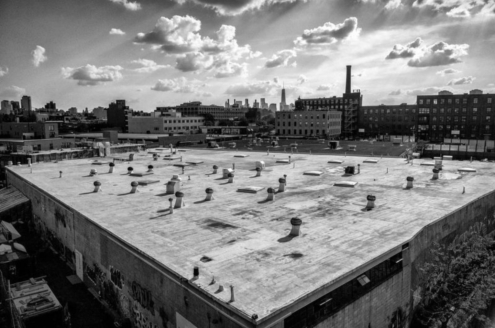
Keith Goldstein has captured this stillness in his work titled Rooftop. He invites us to look down at the city not as a place of transit, but as a place of quiet, rhythmic design. Does this view change how you see the rooftops in your own neighborhood?
 Trapped Soul by Sagar Makhecha