The Geometry of Play
In the physics of childhood, time does not move in a straight line. It loops and eddies, much like the water in a river that has seen empires rise and fall upon its banks. We often think of play as a frivolous expenditure of energy, a way to pass the hours until the serious business of adulthood begins. But watch a game unfold in an open space, and you see something else entirely: a complex, unspoken geometry. It is a series of agreements made in the dust, where the boundaries are fluid and the rules are subject to the whims of the wind. There is a profound gravity to these moments, a weight that anchors a person to a specific patch of earth forever. We spend our later years trying to recapture that singular, unselfconscious focus, that state of being entirely consumed by the movement of a ball or the reach of a hand. If we could only hold onto that blur of motion, would we still feel so tethered to the rigid ticking of the clock?
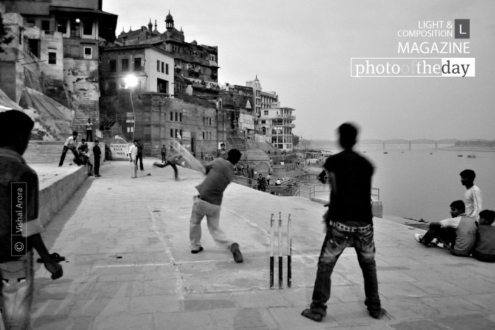
Vishal Arora has captured this fleeting, kinetic energy in his work titled Cricket on Stones. It is a beautiful reminder of how life persists in the spaces between our expectations. Does this image stir a memory of a game you once played?